Arms Are for Linking: Global Protests Target Weapon Manufacturers With Ties to Israel
A decentralized global network of activists is carrying out non-violent actions to disrupt companies that support Israel’s war machine.


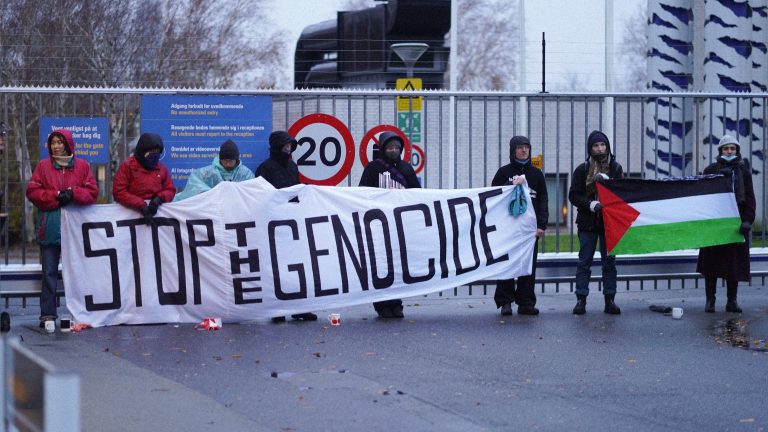
LYSTRUP, Denmark — Early in the morning of Nov. 14, residents of this quiet suburb watched through the wind and rain as something out-of-the-ordinary happened on Hovmarken Road. Fifty anti-war protesters blocked the entrances to the corporate headquarters of the Terma Group, one of the Unites States’ key partners in manufacturing the F-35 warplane, which is being used by Israel to rein bombs down on Gaza.
Mocking the company’s slogan, the demonstrators wielded banners that read “Terma: Allies in Innovative War Crimes” and “Stop the Genocide.”

“The world’s biggest [non-nuclear] bomb was used several years ago in Afghanistan. They killed a whole village — children, elders, innocent women… I lost a lot of my family in the war in Afghanistan,” Sohrab, an Afghan taxi driver who lives in the nearby city of Aarhus, said at the demonstration.
“Who is the victor here? It’s those who are producing these weapons,” Sohrab added. He initially passed by the demonstration on his daily taxi route. He later returned with thermoses of hot coffee and trays of cookies for the demonstrators. “If you are producing weapons that are killing innocent people, then you are as guilty as the people doing the killing,” said Sohrab.
COORDINATION ACROSS BORDERS
The action against Terma that took place in Lystrup was part of a larger decentralized global movement that has been ignited by Israel’s genocidal assault on Gaza. The movement uses direct action to disrupt sites with links to arms manufacturers who supply weapons to Israel.
This marks the first time a furor of such militant action has been carried out on this large of a scale and by this many groups. However, blockades and other forms of direct action in opposition to the Israeli occupation of Palestine are not new. Since Zionist incursions began more than 100 years ago, there has been mass organized action against it in Palestine and the greater Arab world.
On Dec. 6 and 7, the Danish coalition that shut down the Terma Group three weeks earlier coordinated with activists to stage synchronized actions in Copenhagen, Netherlands, Scotland, France and the UK, specifically targeting weapon’s manufacturing offices and plants. The rapid growth of disruptive protests in Denmark have been catalyzed by an Oct. 16 call by the Palestinian General Federation of Trade Unions to “halt the sale and funding of arms to Israel — and related military research.”
At the Lystrup protest, David, a stateless Palestinian living in Denmark, said, “Being here means demanding human rights, here in Europe and all over the world. As Palestinians we haven’t had our human rights for over 75 years. … My parents, grandparents, and I have lived in 15 different countries. We have never had the opportunity to have a passport or citizenship in any of these countries. My passport says I am stateless.”
Palestinians constitute the world’s most extensive stateless community. As of 2018, of the 13 million Palestinians worldwide, nearly 8.7 million have been forcibly displaced. Many of the protests calling for a ceasefire in Gaza, and before Oct. 7 for Palestinian freedom more broadly, are being organized by Palestinian diaspora responding to calls coming from Palestinians living in Palestine.
In the UK, Palestine Action, which organizes protests targeting Elbit Systems, Israel’s largest arms manufacturer, has already made progress. The group forced the closure of Elbit’s head office in London and the cancellation of contracts between the UK Ministry of Defence and Elbit systems. And the sole recruitment firm for the British operations of Elbit said in an email to Palestine Action that they ended their association with Elbit On Nov. 29, says Palestine Action.
Elbit makes several weapons for Israel including bullets, tear gas and 85% of the drones used by the Israeli army, so with the goal of putting Elbit’s UK arm out of business, Palestine Action’s work is far from finished.
The group was co-founded in 2020 by Richard Barnard and Huda Ammori, a Palestinian living in London. “There wasn’t a democratic process in this country when it came to Palestine,” Ammori told Open Democracy in November. “Direct action was the only route left.”
Ammori said previous tactics she’d tried, such as writing to elected officials, signing petitions and campaigning for divestment were ineffective due to an “institutional unwillingness” to accept the realities of the occupation in Palestine. “I was focusing on institutional complicity — things like university investments and public-fund investments. I truly did believe that that would work.”
Since armed Israeli settlers began increasing their attacks early this year on Palestinians living on the Occupied West Bank, Palestine Action has been pushing an uptick in action.
The “Elbit Eight,” a group of Palestine Action activists including the two founders, are on trial for burglary, criminal damage and blackmail, pertaining to various actions carried out before October.
Many of the protests are being organized by Palestinian diaspora responding to calls coming from Palestinians living in Palestine.
On Dec. 21, the verdict for the Elbit eight will be released. Coinciding with that, Palestine Action is calling for a global day of action against Elbit. This call is being bolstered by the U.S. arm of Palestine Action, which formed in mid-October.
Co-founder of Palestine Action US Fergie Chambers was already friends with a member of the UK branch. “We had the link to the organizing going on in the UK. We knew for a long time that Elbit was present in the US in New England, in Cambridge, but the pieces hadn’t really been put together. And perhaps the mass political moment wasn’t there in this country,” Chambers told The Real News Network.
Palestine Action US first targeted Elbit’s Innovation Center in Cambridge, Mass., on Oct. 12, blocking the entrance and coating it in red paint. The center has been targeted multiple times since then. The group has also led direct actions against Elbit in various cities including Boston; Boca Raton, Fla.; Roanoke, Va. and Merrimack, N.H.
AN EXPANSIVE NETWORK
Actions are being carried out beyond the auspices of Palestine Action or the coalitions targeting Terma. In the first week of November, peace activists in Oakland, Calif., and in Tacoma, Wash., temporarily blocked ships carrying weapons for Israel. On Dec. 7, Activists from the group Stop Arming Israel France blocked the entrance to the offices of Exxelia, a company that manufactures components for Israeli missiles.
Action under the auspices of the Boycott, Divestment and Sanctions (BDS) movement that came out of Palestine two decades ago — divestment from the Israeli arms trade being one of its goals — has also seen an uptick since Oct. 7. Puma, which has been the sponsor of the Israeli soccer team since 2018, dropped its sponsorship in a major BDS win. The United Auto Workers has called for a ceasefire and pledged to look into their economic ties with Israel. And in the UK on Dec. 8, 89% of Queen’s University Belfast student union voted for a position that called for divestment from military and colonial projects and the ending of all ties with arms firms. The motion also called for the removal of Hillary Clinton as chancellor.
On Oct. 27, over 1,000 union members with Workers for a Free Palestine blockaded four weapons factories in the UK that supply components for the F-35 fighter jet. “Our movement is growing rapidly and gaining more momentum each day,” Jenny, a trade unionist at the action, told Middle East Eye. “We are escalating our tactics, and today’s blockades are seeing unprecedented numbers of people take part.”
On Nov. 9 and 10, trade unionists across six countries and three continents blocked the flow of weapons to Israel. Kayed Awad, secretary-general of the Palestinian Transport Workers Union saluted the actions of solidarity, saying, “Unions have the power to influence and disrupt the arms trade and ongoing war crimes in Gaza. Long live the working class.”
Although it is not a grassroots group, Yemen’s Houthi movement portrays a similar militancy. In protest of the situation in Palestine, the Houthis on Dec. 9 promised to target all ships heading to Israel regardless of their nationality. As a result, westbound ships have had to circumvent the Red Sea and travel all the way around Africa to get to Israel.
‘There wasn’t a democratic process in this country when it came to Palestine … Direct action was the only route left.’
FROM PROTESTS TO STRIKES
There has also been a global outpouring of massive protests, with groups of tens and even hundreds of thousands marching in the world’s largest cities since Hamas’ Oct. 7 attack on southern Israel. From Oct. 7–27, at least 4,200 actions for Gaza took place across the world, according to Armed Conflict Location and Event Data Project. Since then, protests have continued steadily, on track with Israel’s amassing of war crimes.
South Africans marched in Johannesburg on Nov. 29, shutting down the Nelson Mandela Bridge. On Dec. 2, the group Armenian Nonviolence staged an action in Queens, New York. And on Dec. 8, the town of Guernica, Spain, held a solidarity action calling for the ending of the genocide in Gaza. In Cuba, President Miguel Días-Canel led a protest of thousands along Havana’s iconic Malecón on Nov. 24 demanding an end to the assault on Gaza.
The largest concentration of protest has been in countries throughout the Middle East, with demonstrations occurring despite authoritarian governments. A spontaneous rally even erupted in Cairo’s Tahrir Square (a central site of the Arab Spring).
The Brooklyn-based, Palestinian-founded group Within Our Lifetime Palestine (WOL) — which has already led more than 30 disruptive marches around New York City, almost always attended by thousands of protesters — has been organizing in coalition with Palestine Action. WOL has released maps depicting clusters in Manhattan and Downtown Brooklyn of locations with close ties to Israel. Since the group released the maps, their network of members and followers have organized direct actions at some of the pinpointed places.
The anti-Zionist group Jewish Voice for Peace has been organizing shut-down protests at various key locations across the country, such as the Bay Bridge from Oakland into San Francisco, on Capitol Hill, and in New York City at Grand Central Station and the Statue of Liberty.
In Washington, D.C., on Dec. 11, 18 elderly Jewish women were arrested after chaining themselves to the fence in front of the White House, demanding President Biden support a ceasefire. The protesters read the names of Palestinians killed by Israel since Oct. 7 as a part of a one-day global strike for Palestine.
The strike call was announced by Palestinian National and Islamic forces, a coalition of major Palestinian factions, in response to the U.S. veto of the United Nations Security Council’s 14-1 vote in favor of a ceasefire in Gaza. Leaders of pro-Palestine movements directed people to take the day off from work, to avoid spending money and to participate in protests.
Another one-day global strike call has been announced for today, Monday Dec. 18.
There was scattered participation around the world. More than 270 businesses closed in Detroit. Here in New York City, Balady grocery store in Bay Ridge, Duzan restaurant in Astoria and Fulton Mini Mall in Bed-Stuy were among those that closed their doors in solidarity. The one-day strike was most fully realized in the Occupied West Bank, where businesses, schools, government offices, universities, banks, factories and public-transportation companies all participated.
Instagrammer Shlomo Yitzchak @shlomoyitz promotes direct action against Israel and its allies. On the eve of the strike, he said in a reel, “We first tried with protests, which is really important when a government listens. Unfortunately, the governments we live under are not listening to our demands. … Direct-action campaigns are not about outsourcing our power and asking the governments that represent us to act on our behalf; rather, direct action is saying, ‘If you are not going to listen to us, we collectively are going to step into our power together and use mass non-violence to force change.’ That is what’s happening right now.”
Another one-day global strike call has been announced for today, Monday Dec. 18.
• • • • • • • • • • • • • • • • • • • • • • • • • • • • • • • • • • • • • • • • • • • • • • • • • • • • • • • • • • • • • • • • • • • • • • • • • • • • • • • • • •
WAR IS A BIG BUSINESS!
The Israeli Defense Forces (IDF) have a fleet of over 75 F-35 fighter jets, many of which are currently conducting deadly airstrikes throughout the besieged Gaza Strip. The IDF’s use of the warplane has been connected to previous war crimes, according to Human Rights Watch.
Terma Group manufactures components essential to the F-35. In the past fiscal year, Terma has claimed over $328 million in revenue with 92% of business conducted outside of Denmark.
Many of the direct actions targeting weapons companies may be seen as a result of the recently-surging trend in European rearmament. After Russia’s incursion into Ukraine, 2022 marked the steepest yearly increase in military expenditure in Europe in the past 30 years, according to Stockholm International Peace Institute (SIPRI).
But even before the Putin-NATO conflict erupted last year, the international arms trade was expanding. Military expenditure in the West has been steadily increasing even prior to the 2022 Russia-Ukraine conflict. Since 2017, military expenditure by European states has been increasing by 5% per year according to SIPRI. 2022 saw a 13% increase of $477 billion USD in military spending by the European Union.
And, the United State’s budget deficit has exploded to a staggering $2 trillion, $106 billion of which can be attributed to “emergency foreign military aid budget,” doubling from the previous $1 trillion from the previous fiscal year, according to the U.S. Treasury Dept. The Department of Defense has budgeted $773 billion for fiscal year 2023 and has requested a budget of $828 billion by 2027.
–COLIN MONAHAN
The Indypendent is a New York City-based newspaper, website and weekly radio show. All of our work is made possible by readers like you. During this holiday season, please consider making a recurring or one-time donation today or subscribe to our monthly print edition and get every copy sent straight to your home.
Related Coverage
-

Looking Back on Almost 20 Years of BDS: An Interview with Riham Barghouti
An international boycott movement of Israel can play the same role that it did in apartheid South Africa, says Riham Barghouti.
-

The Second Nakba: Israel is Attempting to Erase Palestinian Gaza
The city at the crossroads of Africa and Asia has a rich history, its preservation at stake.
-

From NYC to Palestine: Grassroots Movements Speak Out on Israel-Gaza War
Grassroots orgs that fight police brutality, landlord evictions, school budget cuts and more are embracing the Palestinian struggle as their own.