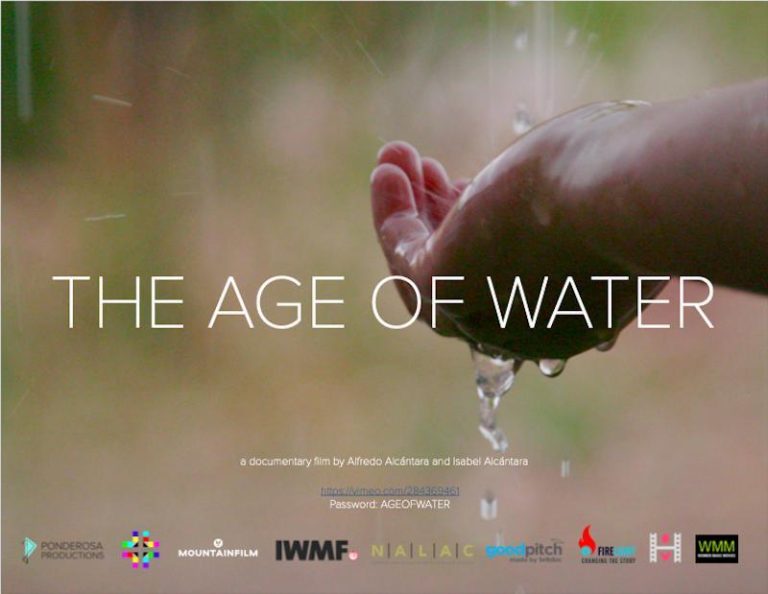
“La Edad de Agua” Reveals the Price of Water
A group of activists—and grieving mothers—fights to understand the truth about where their water supply went, and how it may have become deadly.

The Age of Water / La Edad de Agua opens with an unnamed narrator telling viewers that once upon a time, in the not-too-distant [but unspecified] past, the town of La Cantera in the Mexican state of Guanajuato had many rivers and natural springs. “Now there are barely any,” she says. “Why?” “What happened?”
These questions are at the heart of The Age of Water, a film directed by siblings Isabel Alcantara Atayala and Alfredo Alcantara. But they’re not the only questions that this searing film asks. In fact, the film not only asks why the once verdant town has become arid—but it also asks why three elementary school aged girls died of leukemia and why severe tooth decay and other ailments have become pervasive among a multiplicity of local residents.
The film centers on two grieving mothers, Nelly Baeza and Elia Zarazua, as they mobilize, organize, and pressure lawmakers to investigate why their daughters died and why their friends and neighbors are getting sick. They also urge the government to explain why once-abundant waterways have gone dry.
The organization they created, MAYOYE, is an amalgam of the names of their three deceased kids, Mafer, Yoselyn and Yessica and the film tracks the women’s intrepid work in forcing local, state, and federal officials to test their tap water for contaminants. Thanks to support from a hydrogeologist from the Universidad Autonoma de Mexico and several doctors, what they discovered appalled – and terrified – them.
While the area is home to some of Mexico’s largest farms and sends hundreds of thousands of pounds of asparagus, salad greens, lettuce, and strawberries to the U.S. and Canada each year, the farmers have met the growing demand for these products by taking massive amounts of water from aquifers. Concomitantly, these growers have piped aquifer water to the US Southwest for hefty fees.
In the short term, this has allowed Mexican agribusiness to cash in.
But the majority of the La Cantara townspeople have paid the price for this. The Age of Water informs viewers that replenishing the aquifer’s water will take thousands of years. Worse, the excessive extraction has allowed radon, a carcinogenic gas, to come to the surface. And that’s not all: We also learn that once this gas enters the body, it does not leave and instead bombards the cells, causing illness and, in some cases, premature death. Moreover, when La Contera’s water was tested, it was found to have high concentrations of arsenic and fluoride, both of which are linked to cancer, tooth decay, and delays in intellectual development.
The members of MAYOYE have worked tirelessly to publicize these dangers and hold elected officials accountable for rectifying the damage. But, perhaps predictably, the pushback against them has been fierce. Bureaucrats from Conagua, the Mexican water administration, and other local agencies have contested the study’s claims and have denounced the findings—one official going so far as to drink a huge glass of polluted tap water in front of community members as he pooh-poohs the report. Many community residents have also rejected the claims of contamination since they cannot afford to buy bottled water, opting instead to ostracize and harass the MAYOYE activists (one of whom felt pressured to quit her job as a kindergarten teacher and subsequently moved away) as if they, and not greedy corporate farmers and their government enablers, caused the problem.
It’s a depressing result. At the same time, the film closes on a somewhat hopeful note, reporting that in 2024, La Cantera’s newly elected Mayor, Juan Carlos Castillo Cantero, vowed to build a rainwater harvesting system that, in conjunction with reverse osmosis water filters, will remove fluoride and arsenic and make tap water safe to drink.
It seems clear that the women of MAYOYE will do everything they can to make sure that he keeps this promise.
The Indypendent is reader-funded. We publish a free monthly newspaper, a website, a weekly radio show on WBAI-99.5 FM and more. To make a one-time or recurring monthly donation, click here.
Related Coverage
-

A Revolutionary Fantasy That Speaks to Our Current Descent into Despotism
In One Battle After Another, the rebels savor the thrill of fighting back against an oppressive system but pay a brutal price for doing so.
-

Book Excerpt: Gotham at War: A History of New York City from 1933-1945 by Mike Wallace
Mike Wallace concludes his trilogy of New York City history with a chronicle of the American anti-fascist movement’s beginnings in NYC.
-

A Guide for Activists in "READ THIS When Things Fall Apart"
READ THIS When Things Fall Apart provides a place for activists new and old to find comfort and wisdom.