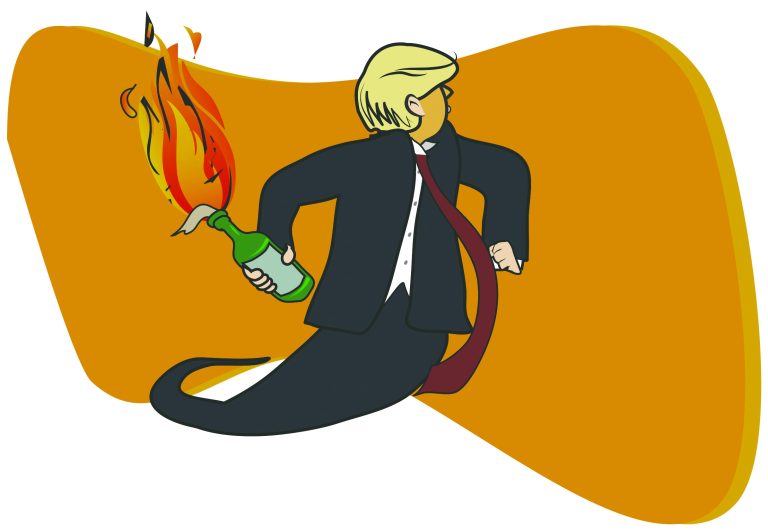
What is Antifa?
Like the unlawful domestic intercepts that the PATRIOT Act secretly authorized, critics say these new attacks on dissent and the right to freedom of speech and association pose more of a threat to the stability of the country than the Antifa menace Trump tries to conjure up — which is a far cry from its glory days.


When a mix of 300 ICE, FBI and Border Patrol agents in combat gear descended from a Black Hawk helicopter and burst out of box trucks to conduct a middle-of-the-night raid at a Chicago apartment complex on Sept. 30th, their stated mission was to find members of Tren de Aragua, just like those the U.S. military claimed were onboard boats they blew up in the Caribbean.
The same day of the Chicago raid, President Trump instructed some 800 U.S. generals summoned to Marine Base Quantico to use cities “run by the radical left Democrats…as training grounds for our military” for what he called a “war from within.”
“San Francisco, Chicago, New York, Los Angeles, they’re very unsafe places. And we’re going to straighten them out,” Trump vowed.
At some point on that same busy day, the White House issued a press release that added another city to the list.
“The Radical Left’s reign of terror in Portland ends now, with President Donald J. Trump mobilizing federal resources to stop Antifa-led hellfire in its tracks,” it announced, bemoaning the “premeditated anarchy that has scarred the city for years, leaving officers battered, citizens terrorized, and property defaced.” Trump first deployed federal troops to Portland in 2020 after some people at protests demanding justice for the police killing of George Floyd hurled molotov cocktails and other objects. In a now infamous address to the National Association of Police Organizations, Trump blasted demonstrators in “Portland and other cities” who “have cans of soup. Soup. And they throw the cans of soup… And then, when they get caught, they say, ‘No, this is soup for my family.’”
Now, Trump is expediting his war on “Antifa,” under which he lumps together liberals, leftists, radicals and socialists and anyone else he dislikes. While the actual American anti-fascist movement is currently decentralized, leaderless and small, he targeted Antifa in two sweeping measures in the days before the Chicago raid that suggest it could indeed be a training exercise.
First he signed an Executive Order designating Antifa as a “domestic terrorist organization” and outlined a “new law enforcement strategy that investigates… the organized structures, networks, entities, organizations, funding sources, and predicate actions behind them.”
Then in a much broader national security presidential memorandum, known as NSPM-7, Trump instructed the FBI’s 200 Joint Terrorism Task Forces to “disrupt networks, entities, and organizations that foment political violence” — including conduct that expresses “anti-Americanism, anti-capitalism, and anti-Christianity” – and to do so even “before they result in violent political acts.”
They are targeting “pre-crime,” wrote journalist Ken Klippenstein, who has called NSPM-7 a “sweeping policy decree for the defense, foreign policy, intelligence, and law enforcement apparatus” that is “the most important change in the expansion of government power since the PATRIOT Act.”
Like the unlawful domestic intercepts that the PATRIOT Act secretly authorized, critics say these new attacks on dissent and the right to freedom of speech and association pose more of a threat to the stability of the country than the Antifa menace Trump tries to conjure up — which is a far cry from its glory days.
We’ve Been Here Before
In 1933, future New York mayor Fiorello La Guardia drew 100,000 people to Washington Square Park for an anti-fascist protest against the rise of authoritarianism in Europe. In 1935, some 200 leftwing and liberal faculty at CUNY’s City College founded the Anti-Fascist Association and wrote in their inaugural bulletin: “We recognize that Fascism can result only in the degradation of art, science and culture; intense nationalism; racial discrimination; enforced labor; the suppression of civil rights, including academic freedom; militarization; lowering the standard of living; and denial of equality to women.”
An exhibit called “Facing Fascism” at the Museum of the City of New York documented how, between 1936-1939, New Yorkers made up the bulk of some 1,000 Americans who “died fi ghting to protect the elected government of the Spanish Republic against a rebellion led by General Francisco Franco and backed by Hitler and Mussolini.”
As Americans debated how to respond to the rise of fascism, actual fascists valued the discord. “Nothing will be easier than to produce a bloody revolution in the U.S.,” wrote Hitler’s Propaganda Minister, Joseph Goebbels, in 1933. “No other country has so many social and racial tensions. We shall be able to play on many strings there.”
The American anti-fascist movement was largely dormant until it grew in response to Trump’s election in 2016 and return to power in 2025, and has been part of protests against ICE arrests, prompting New York Mayor Eric Adams to blast “members of Antifa that have made their way into the city.”
As politically-motivated violence surges, Trump and his echo chamber have tried to pin the blame on an organized conspiracy by the left. In a recent column supporting NSPM-7, Douglas Murray in the New York Post claimed the bullets used by Charlie Kirk’s assassin were “literally carved with Antifa slogans.”
When members of the American anti-fascist movement became the target of McCarthyism in the 1950’s, the Communist Party USA released an open letter “to all our fellow Americans, irrespective of political faith” that warned: “The bell tolls not just for the Communists alone, but for the hard-won rights of all Americans. All must act together to save American constitutional liberties.”
As The Indypendent went to press, more than 3,700 non-profi t groups published an open letter condemning NSPM-7 and Trump’s “e¤ orts to defund, discredit, and dismantle nonprofi t groups he disagrees with” as “reprehensible and dangerous—a violation of a fundamental freedom in America.”
Renée Feltz is News Director at Democracy Now!
The Indypendent is reader-funded. We publish a free monthly newspaper, a website, a weekly radio show on WBAI-99.5 FM and more. To make a one-time or recurring monthly donation, click here.
Related Coverage
-
 Bring boots. The bullshit is getting thick. I mean ankle deep, bullshit. The aftermath of the Charlie Kirk assassination…
-

From Albany insider to card-carrying socialist, former Cuomo aide, whistleblower reflects on her political journey
-

Universities That Believe in Nothing
(Photo credit: Neil Constantine)