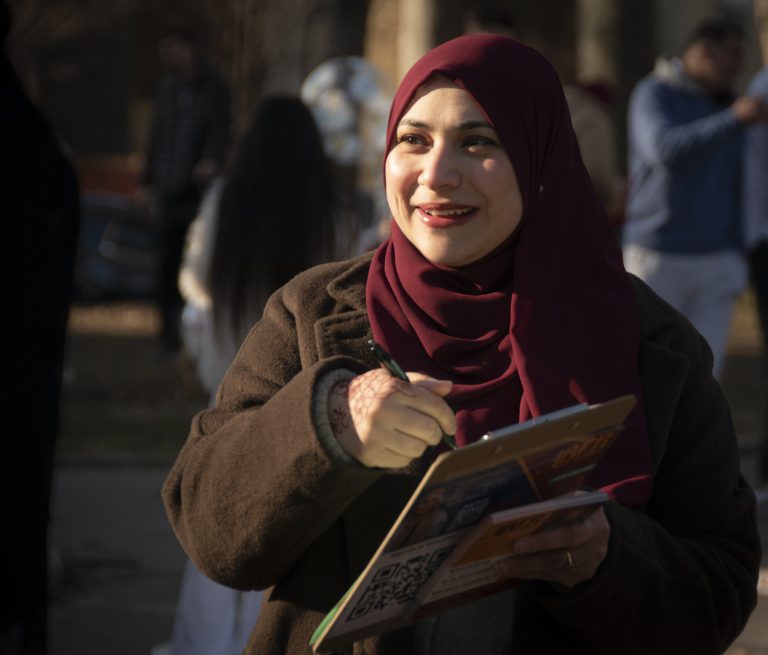
Interview: State Senate Candidate Aber Kawas Touts Support for Affordability Agenda
Kawas is running as the NYC-DSA-endorsed candidate for District 12


Aber Kawas came of age as a Muslim in post-9/11 New York. NYPD surveillance and fears of terrorist plots emanating from her community were pervasive if unfounded. Kawas’s father was deported to Jordan when she was 16. Kawas responded by throwing herself into community organizing. She drew inspiration from social movements like Black Lives Matter and the struggle for indigenous rights at Standing Rock, North Dakota.
Kawas’s disinterest in electoral politics began to change when she worked on the 2017 City Council campaign in Bay Ridge of Khader El Yateem, a Palestinian Lutheran pastor and socialist. It was there she met a fellow Muslim, Zohran Mamdani, who was El-Yateem’s canvassing director.
“That was my first time that I was like, ‘Oh, I would want to knock doors for this person,’” Kawas recalls.
Mamdani was elected to the State Assembly from Astoria, Queens in 2020. In 2023, he introduced Not On Our Dime, a bill crafted by Kawas, that would target tax-exempt charities that provide assistance to Israeli settler organizations. After Mamdani’s mayoral win last year, she was recruited by New York City DSA to run for an open state assembly seat in Western Queens. She subsequently switched to State Senate District 12 after longtime incumbent Michael Gianaris announced he was retiring. Kawas is running as the NYC-DSA-endorsed candidate in a district made up of the neighborhoods Astoria, Long Island City, Sunnyside, Woodside and Maspeth—that voted heavily for Mamdani. She would be the first Palestinian-American to serve in the state legislature. Her opponent, Stephen Raga, is a two-term Assemblymember from Woodside.
In the second week of Ramadan, I met Kawas to discuss her campaign on Steinway in Little Egypt, in MOKAFÉ, a Yemeni coffee house with several locations in New York and New Jersey. It was nearly empty midday, with most people in the community fasting for the holy month. Kawas said she enjoyed the café for the way it “facilitates community conversations.”
“I know that the Zohran campaign used to do a lot of work in the back,” she told me.
Our conversation centered what she called both the heart of her campaign and her work as a community organizer: immigrant and Palestinian rights.
This interview has been edited for brevity and clarity.
Indy: You initially hesitated when approached about running for office, but were eventually won over. Talk about that hesitation and where it came from.
Aber Kawas: A lot of the context of why I was recruited and the timing of it related to when Zohran won the mayoral primary. Everybody has the experience of “Oh my God, what the heck just happened?”
There’s a lot of forces of power that don’t want us to succeed, don’t want us to change systems, and I felt it was really important that we had people run for office and go into office who are going to try to sustain the wins and the things that we were fighting for.
You didn’t always buy into electoral politics. Was Mamdani’s victory a major factor in that shift?
It was a factor. Being a Muslim organizer post-9/11 and being Palestinian, I’ve had two decades of experience of seeing politicians really not stand up for our community and also give a lot of false promises.
I worked with Zohran after he won his Assembly seat, and we built the Not On Our Dime campaign together. For me as an organizer, that was me witnessing somebody who comes from an organizing background actually benefit us when they are in office. He consulted with people on an intervention that we can make at the state level. And then we sat and developed the bill together, we also sat and developed the strategy. That was something that I saw as an overall benefit.
Being a Muslim organizer post-9/11 and being Palestinian, I’ve had two decades of experience of seeing politicians really not stand up for our community and also give a lot of false promises.
As an organizer, I always saw myself being on the outside. I had to be the person bringing people to speak to the people in office. But actually there’s a possibility that as an elected official, I can continue to have a relationship with the organizers on the ground, that we benefit more when this is not an isolated process. I witnessed it as a possibility, and want to build on it to be a model we should continue.
How much of your agenda is an extension of Mamdani’s affordability agenda and how much of it is your own goals?
It feels pretty related. And it’s really important for us on the left to achieve that agenda. Especially taxing the rich, to have more resources to fund more social services that make people’s lives more affordable.
Palestine and the genocide, it’s obviously very near and dear to you. It’s not very near and dear to everybody in the city. How do you balance that?
There has always been an assumption that if you are outspoken about Palestine, that you will not be successful as a politician. What’s been really amazing about Zohran winning the mayoral election is throughout his political career, he has been outspoken about Palestine. In many ways that was something that differentiated him from other candidates. It was something that endeared him to people. When you are reflecting a politics that is based in human decency, that is what people are looking for.
As you head towards the June 24 Democratic primary, where do you think you need to bolster your campaign, if at all?
The best part about a campaign is when you actually hit the streets and talk to people. There are many different people all across the district who, now more than ever, are interested in being politically engaged in decisions that are being made for them by elected officials. And I think we need to grow that and go to parts of the community where people maybe are less politically engaged.
Since you’ve been talking to people, what have you learned about your district that you didn’t know before?
I’ve really enjoyed having small fundraisers, because then I will meet like 40 people who live in the district, and they’ll all mention a different thing that [they] are thinking about. The greatest part of all of this is that it’s a great learning experience. You need to be in conversation with people.
Something that I love to do is I’ll ask somebody who lives in the district to meet for coffee and just walk me around your neighborhood and tell me about, like, how you grew up here and things like that. Most of the time, people who are in office, they have consultants, people who are policy experts through studying it through university. I’ve been really excited about learning about my policy goals through the everyday experiences of people that I meet in district and through those meetings.
What do you think is the most common thing that people were surprised to know about you?
It’s just been nice to share my story with people. When you’re a Palestinian, when you’re a Muslim woman who wears a hijab, people can look at you and assume what your politics are.
The Indypendent is a New York City-based newspaper, website and weekly radio show. All of our work is made possible by readers like you. During this holiday season, please consider making a recurring or one-time donation today or subscribe to our monthly print edition and get every copy sent straight to your home.
Related Coverage
-

Muslim Civil Rights Advocate Repositions Campaign for State Senate
Aber Kawas, a Palestinian American and democratic socialist, wants a more affordable Queens.
-

Here’s Why Darializa Avila Chevalier Can Win Another Shocking Upset for the Left in NY-13
The DSA-backed community organizer poses a formidable threat to five-term incumbent Adriano Espaillat.
-

Tax the Rich Supporters March on State Capital
A DSA-led coalition is calling on Albany to enact three bills that would raise at least $32 billion annually.