Who Killed Maria Hernandez?
New evidence emerges that prosecutors cut corners to put away an innocent man.

The saga of the Central Park jogger and the exonerated five began that April. The murder of Yusuf Hawkins happened a few weeks later in Bensonhurst, just before the September Democratic primary for mayor. When community activist Maria Hernandez was gunned down in her Bushwick home in early August 1989, the violence sparked comparable outrage.
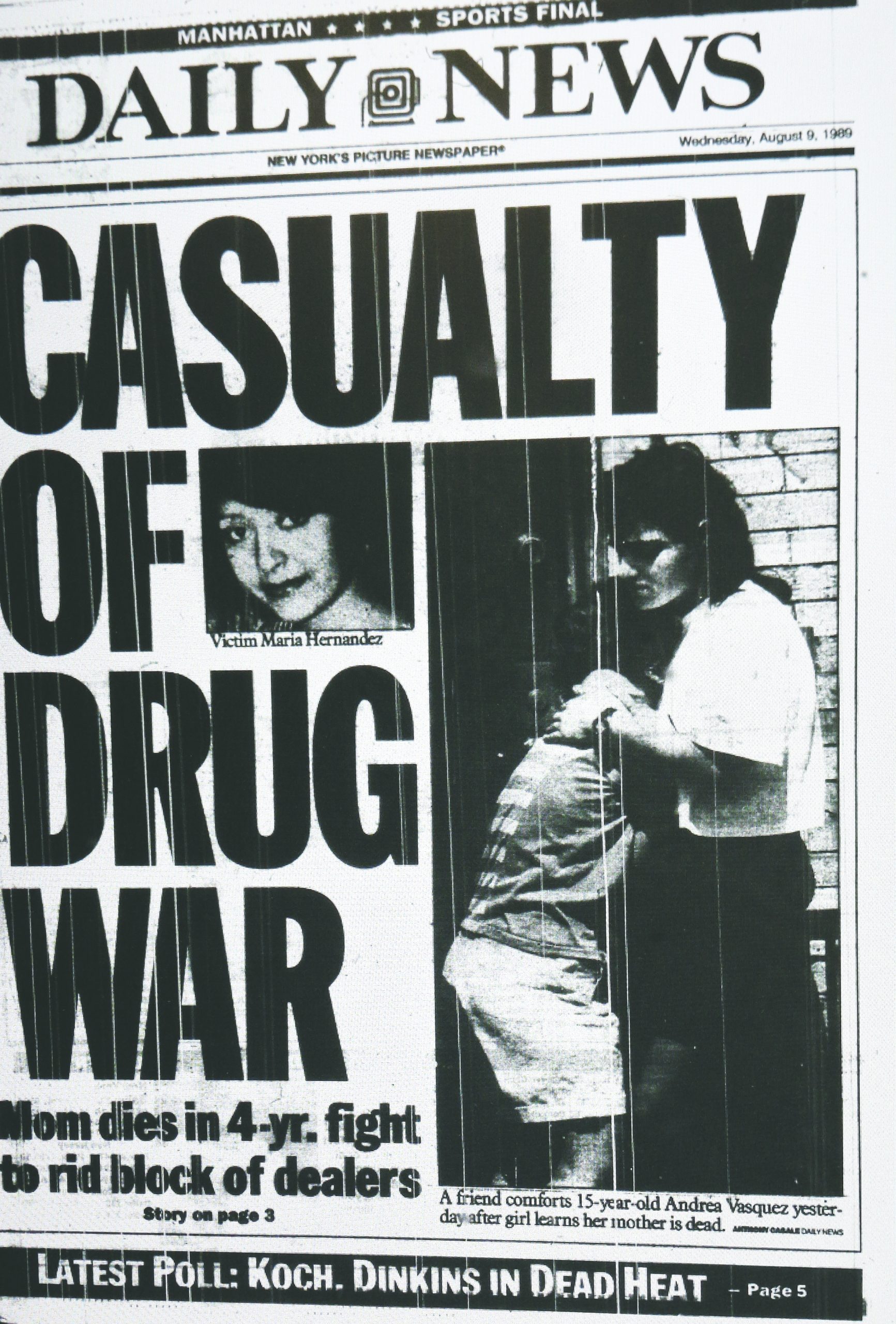
The story splashed across the tabloids, with the cover of the Daily News calling Maria a “Casualty of Drug War.” Mayor Ed Koch and his Democratic challenger David Dinkins attended Hernandez’s funeral, along with Curtis Sliwa and a phalanx of his fellow Guardian Angels.
So dramatic was the murder that even the staid New York Times editorial board joined in the outrage. In an entry titled “The Bushwick Terror,” The Times declared, “[T]he drug terrorism that apparently took Maria Hernandez’s life is the product of organized criminal activity. It is nothing less than an armed challenge to duly constituted authority, a challenge for anyone who would serve as mayor of New York City.”
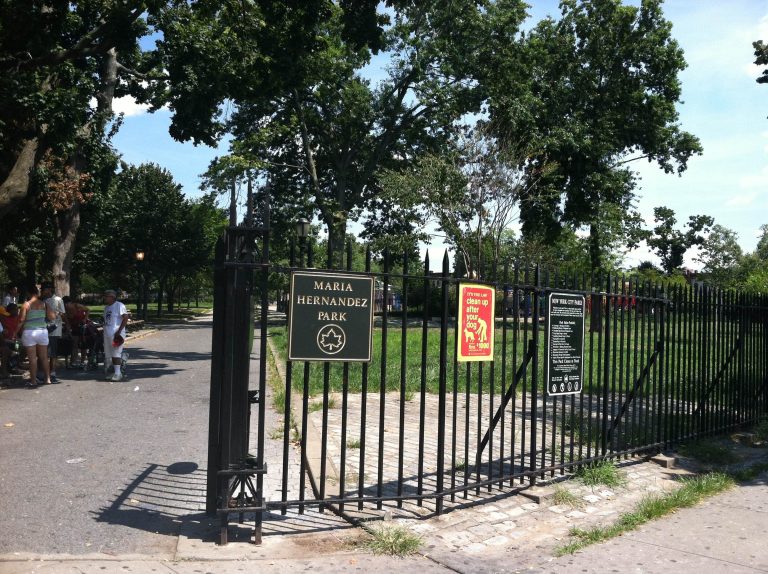
The NYPD initially searched for three suspects, believing the murder had been committed by local drug dealers angry that Maria and her husband Carlos Hernandez had been clearing their Starr Street block of heroin and crack. In September, while Dinkins toppled Koch in the Democratic primary, cops arrested two men for Maria’s murder. Although Carlos Hernandez endorsed Republican Rudy Giuliani in the November election, Dinkins prevailed. Just before leaving office at the end of the year, Koch signed a City Council bill renaming Knickerbocker Park in honor of Maria Hernandez.
In early 1991, the Brooklyn DA’s office — then under Charles “Joe” Hynes, first elected in 1989 — won two convictions for the Hernandez murder. In separate trials, prosecutor Marianne Crosley persuaded two different juries that Willie Figueroa and Harry Santiago fired at the Hernandez home in an early morning drive-by shooting, with a bullet fatally striking Maria as she dressed for work.
More than three decades later, Figueroa, 62, remains incarcerated, with over a decade to go before his first appearance before the parole board. Last summer, Santiago got out on parole. Both defendants have long maintained their innocence. An Indypendent review of their trials bolsters their claims — and calls into question the role played by Carlos Hernandez in the case.
• • •
There is no dispute that Figueroa and Santiago were dealing drugs in the summer of 1989. They were by no means the only ones doing so in Bushwick, however. Articles in the tabloids described the blocks around Knickerbocker Park as an open-air drug market. Figueroa’s street name was “Willie Bundles,” a moniker he acquired because of the small bags of heroin he dealt. Upon Figueroa’s arrest, his Greenpoint-based father told the New York Post that his son had a crack habit, but that he and Willie were in Springfield, Mass., at the time of the slaying.
In mid-September 1989, five weeks after the Hernandez murder, cops charged Figueroa after a lengthy interrogation in which he made an incriminating statement on videotape. A crowd of 250 Bushwick residents surrounded the 83rd Precinct for the perp walk. When a Post reporter at the scene asked if he had killed Hernandez, Figueroa replied, “No.”
To this day, Figueroa maintains that his statement to detectives was coerced. In it, he claims to have fired a .357 Magnum twice into the Hernandez home, adding that Santiago paid him to do so.
At the time of Figueroa’s arrest, Hernandez told reporters that Figueroa was one of the many area drug dealers that he had battled with. According to Hernandez, Figueroa had swung a golf club at him one year earlier. “I always knew they were capable of carrying out [their] threats,” Hernandez stated regarding Figueroa and his purported accomplices.
Figueroa, however, makes a starkly different claim. “I did not have any contact with Carlos Hernandez at all. Ever!” Figueroa recently told The Indy. At the 1991 trial, Hernandez was the key witness who testified against Figueroa.
At the outset of the murder investigation, the commanding officer from the NYPD’s Brooklyn North division explained to reporters that Carlos Hernandez was “a street activist, very prominent and active in providing the department with narcotics information.” During Figueroa’s trial, defense attorney Mark Pliskow brought up a news story that focused on Hernandez’s relationship with the 83rd Precinct.
“I did not have any contact with Carlos Hernandez at all. Ever!” Willie Figueroa told The Indy.
Two weeks after his wife’s slaying, Carlos Hernandez had become a national figure, making the rounds on the TV talk-show circuit, appearing on the influential Larry King show on CNN. As reported by Newsday, Hernandez was angered by the rumor circulating back in Bushwick that he was involved in drug dealing and offered to take a lie-detector test. The “street talk,” a police source told Newsday, was that he “over the past couple years either sold drugs himself or favored certain dealers.”
On the witness stand, Hernandez denied that he was involved in the drug trade. Figueroa later testified, insisting that he was in Springfield at the time of the murder and that detectives had forced him into confessing. After the verdict, a juror told a Daily News reporter that Figueroa’s videotaped statement was the main reason the jury deemed him guilty. Upon leaving court, members of the Hernandez family joined Assistant DA Marianne Crosley for a champagne celebration.
• • •
Soon thereafter, Crosley brought Santiago to trial in front of the same judge, Francis X. Egitto. Figueroa only recently discovered that Crosley relied on different detectives and ballistics experts in the two trials. In Figueroa’s case, the prosecutor’s theory was that he had killed Hernandez with a .357 Magnum.
But according to Figueroa’s current court filing, the .357 was then ruled out as the murder weapon in the Santiago trial. Crosley’s revised theory required new law enforcement witnesses so that they would not contradict previous testimony. Judge Egitto evidently looked the other way.
In both trials, Crosley told the jury that the defendants had committed the shooting while driving by the Hernandez home at 105 Starr St. in Santiago’s red Camaro just after 4:30 in the morning. In the second trial, two mechanics testified that the broken-down Camaro was in their shop at the time of the murder. No witnesses or physical evidence linked Figueroa to the vehicle.
Among the many pieces of information that Figueroa has received amid his challenges to his conviction are two reports (known as DD-5s) from Detective Frank O’Keeffe of the 83rd Precinct. The DD-5s from early on in the investigation provide the name of a rival drug dealer who had turf disputes with both Carlos Hernandez and Harry Santiago. The reports state the dealer then paid another named person to shoot at the Hernandez residence.
According to Figueroa, Assistant DA Crosley did not turn over the DD-5s to the defense at the time of trial. Detective O’Keeffe tells The Indy he does not recall the specific details of his reports. Like Judge Egitto, Mark Pliskow, Figueroa’s trial counsel, is now deceased.
Despite winning the high-profile convictions, Crosley left the Brooklyn DA’s office later in 1991. She has since relocated to the Cleveland area. Reached by email, Crosley initially agreed to field The Indy’s inquiry about the cases. Crosley then did not answer a set of questions focused on Carlos Hernandez’s work with the 83rd Precinct, her reliance on different ballistics experts, or whether she stands by the convictions of Figueroa and Santiago.
Over the past few years, Figueroa has asked the Brooklyn DA’s Conviction Review Unit (CRU) to open an investigation of his case but has not received any updates. His current court challenge is a long shot, given that the judge handling it, Matthew D’Emic, already rejected Figueroa’s previous motion.
On most nights at Eastern Correctional Facility near Ellenville, N.Y., Willie Figueroa can be found in the law library, helping his peers research their cases while working on his own. A baseball enthusiast, Figueroa hopes that one day in the not-distant future, he’ll be sitting at Yankee Stadium watching a ball game.
The Indypendent is a New York City-based newspaper, website and weekly radio show. All of our work is made possible by readers like you. During this holiday season, please consider making a recurring or one-time donation today or subscribe to our monthly print edition and get every copy sent straight to your home.
Related Coverage
-

‘People Are Speaking in Whispers’
Student suspensions, faculty purges and an all-encompassing surveillance state have become the norm as Columbia falls silent after last spring’s anti-genocide protests.
-

Alamo Drafthouse Workers Respond to Mass Layoffs
The layoffs come in the wake of Sony Pictures buying out Alamo las summer. Recently unionized workers are determined to get their jobs back.
-

New Book Looks at the History of Carceral Apartheid
Research reveals the ways resistance inside prisons has been suppressed, propping up an unequal and unjust social order.