Morningside Heights Residents Protest Continued Gate Closure at Fortress Columbia
After nearly two years of continuous disruption to movement in their neighbourhood, community members say it’s time to open up the campus again.

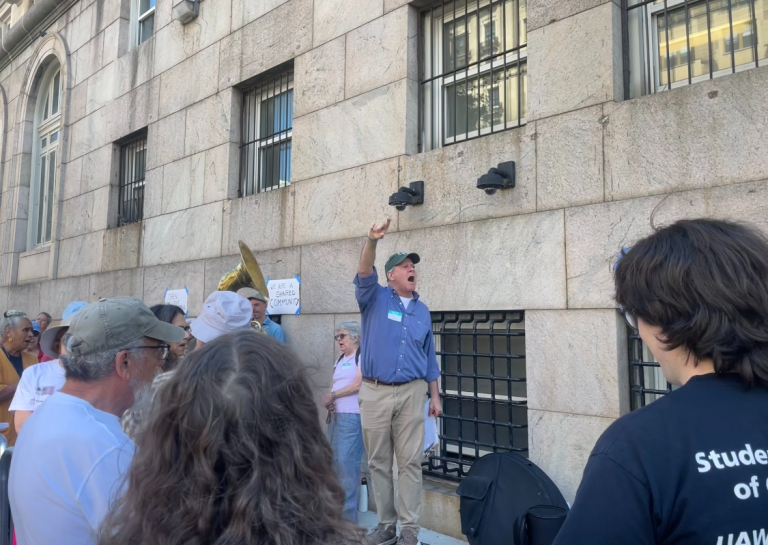
When Columbia University closed its gates on October 12, 2023, few community members would have expected that the college walk between Amsterdam and Broadway would be completely closed for the next two years. On Tuesday, as students began the first day of the fall semester, around three dozen community members rallied on the sidewalk outside the 116th Street entrance to protest the ongoing campus lockdown. They were surrounded by police barricades.
“We’ve been in constant touch with [the] administration of Columbia” said Dan McSweeney, an organizer with the Morningside Heights Community Coalition (MHCC) and a Columbia alum. “We’ve also been in touch with all of our elected officials, with our community board, we’ve organized various events to raise awareness and to help the administration and the Trustees of Columbia understand that what they are doing is neither effective nor in keeping with what the institution stands for.”
McSweeney, who was one of the community members who spoke at the rally, insisted that the university could not justify gate closures with vague “security concerns.” “They [students and faculty] do not feel safer… if anything they feel isolated on campus, because no one from the outside world can access the campus,” he said. “There have been continued disruptions and protests after the gates were closed… Closing the gates has done nothing to increase safety.”
“Any survey of students will tell you they prefer the gates to be open,” said Grant Miner, president of Student Workers of Columbia (SWC), the union representing graduate students at the university, “it makes life tremendously difficult. Students aren’t concerned for their safety from the community. They moved here for a reason, and the majority of students live outside of the gates so they’re going to be inside the community. It’s clearly nonsensical.”
“They’re concerned with crushing protests on campus,” one student leader said. “They’re locking down any hint of dissent.”
In February, the Columbia University Senate polled students on a variety of topics including the prospect of reopening the gates. When asked “How comfortable would you feel if Morningside campus was opened with swipe access to buildings?” 62% of the 12,963 respondents answered “very comfortable” while only 5% answered “very uncomfortable”.
But if the community, faculty, and students stand opposed to the gates being closed, why doesn’t the university open them? For Miner, it’s nothing to do with security, but control. “They’re concerned with crushing protests on campus,” he said. “They’re locking down any hint of dissent.”
Asked how he felt the gate closure affected community relations Miner said “It really worsens them. I’ve seen schools where they take an actively antagonistic stance towards the community that surrounds them… it means that the community sees themselves as unwanted, almost pests to an otherwise prestigious institution. It’s terrible for Columbia and terrible for the education of the students.”
The impact of the gate closure on the community cannot be overstated. With the neighborhood’s subway station located on the west side of the campus at 116th Street and Broadway, residents who live east of Columbia must circumnavigate the campus via 114th or 120th Streets. When speaking at the rally, many of Columbia’s neighbours talked about the quotidian tasks that had been lengthened or denied to them these past two years, whether it be access to the grocery store, a favorite place to sit or the park where they used to walk their dog.
Columbia continues to face legal challenges by community members over its gates closure. In April, the New York County Supreme Court ruled to keep the gates closed until a further hearing. Here, the ambiguity of Columbia’s longstanding agreement with the city has worked to their advantage, allowing them to argue that they have the right to close the street despite claiming since 1954 that the gates were merely “decorative.” Despite the gate closure being totally unprecedented, it may survive legal scrutiny.
Whether or not more protests will force Columbia to act remains an open question. The university is certainly no stranger to resisting the opinion of its community, both within and outside its gates. On the same day as MHCC’s rally, two other protests were held, one organized by Columbia’s chapter of the American Association of University Professors, the other a “practice picket” by SWC which is mobilizing for a new round of contract talks with the university after winning a historic 2022 strike that lasted 10 weeks. Though organizing those “inside” the university, many of their chants and calls echoed similar narratives to those “outside” its walls. The target of their criticism was the same as well: the university administration and the board of trustees.
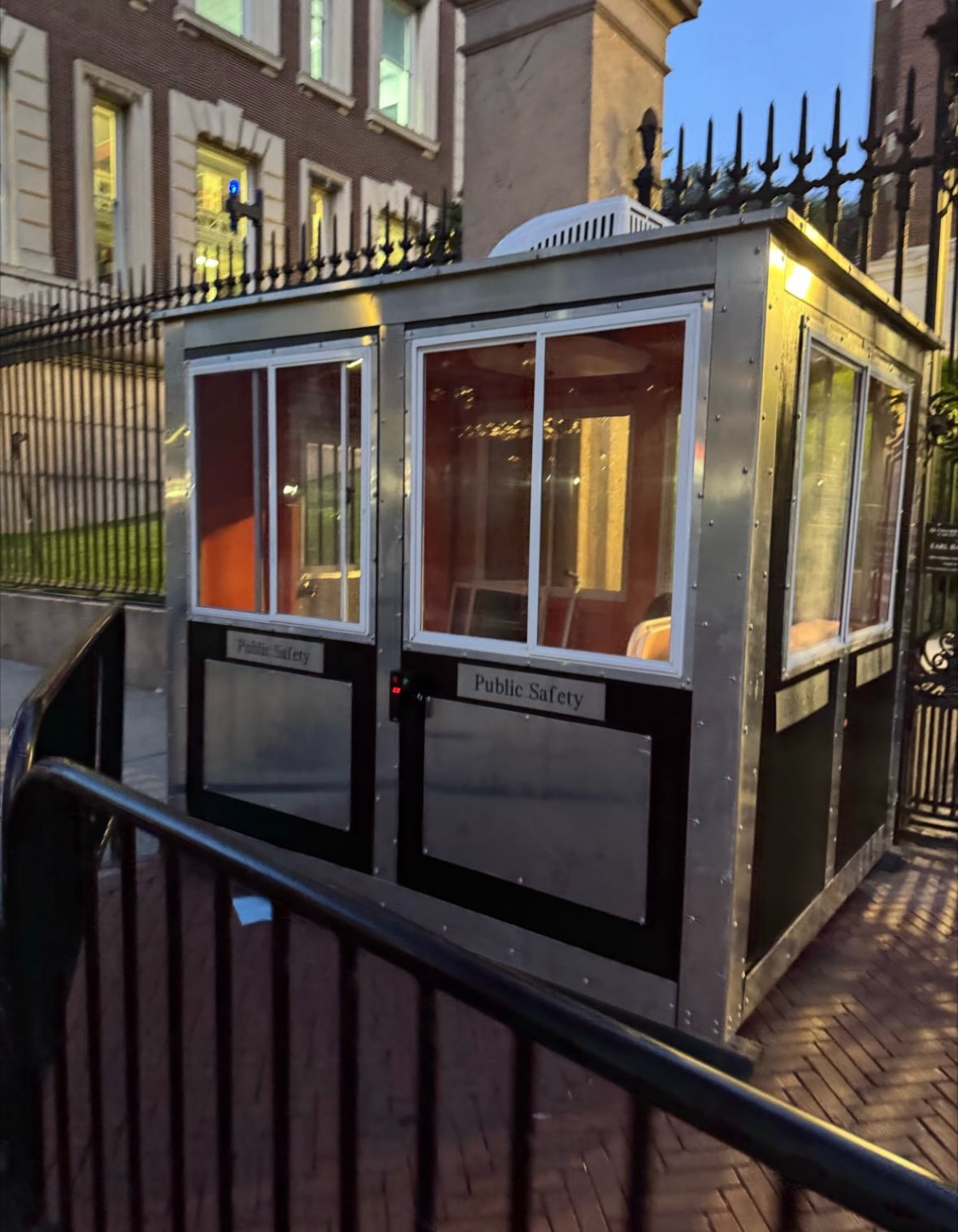
In the past, the combined forces of those within and outside Columbia’s walls have been a revolutionary combination, a fact which helps to explain why despite popular opinion, the gates remain closed. Meanwhile Columbia’s new security checkpoints, installed at each entrance in the last few days, give the undeniable impression that the Trustees do not intend to open up Fortress Columbia anytime soon.
The Indypendent is reader-funded. We publish a free monthly newspaper, a website, a weekly radio show on WBAI-99.5 FM and more. To make a one-time or recurring monthly donation, click here.
Related Coverage
-
 When S, a faculty member at Brooklyn College opened an email from HR in June, the last thing she…
 -

One Year After Encampment Raid, Columbia Asserts Tighter Control over Campus Community
The university’s administration is targeting everything from the university senate to the gates that student protesters recently locked themselves to.
-

Adams Continues Chaos For Deliveristas
Two landmark minimum pay laws vetoed while NYPD targets delivery workers with criminal summons that increase their risk of deportation.