Extra! Extra! High School Journalism Makes a Comeback
Only 1% of NYC journalism students have access to student journalism in their school. Youth Journalism Coalition is fighting to change this.

New York City is the media capital of the United States, if not the globe. And yet, while there are countless media outlets headquartered here, only 1 percent of its public high school students have access to journalism programming at their schools.
The Youth Journalism Coalition is fighting to change this. YJC, an off shoot of media nonprofit The Bell, is made up of students, teachers, newsrooms, and higher education institutions that want to expand New York City public school students’ access to journalism courses.
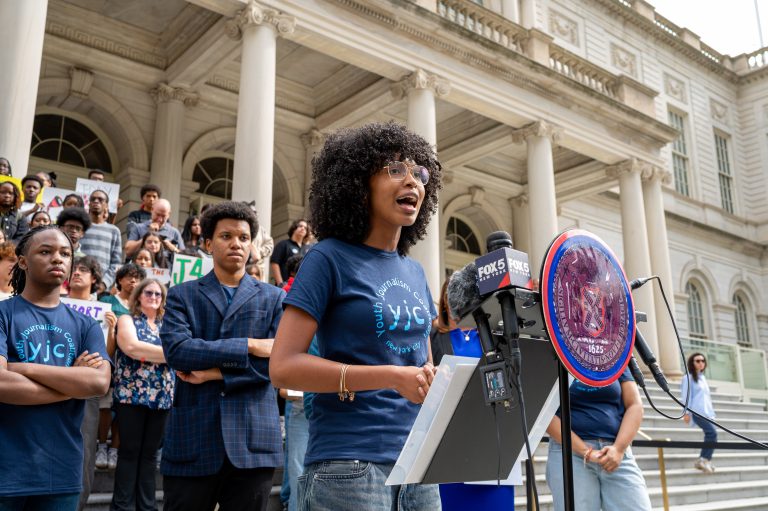
Their main initiative is “Journalism for All,” which launched a year ago. The initiative has already made an impact—causing the City Council to pass legislation requiring new public data on access to journalism courses and student newspapers. This data, which was released in September revealed that only about 3,200 out of 290,000 public high school students were enrolled in journalism programs or courses in their school. Following the release of the data, students rallied on Sept. 16 in front of City Hall to promote the expansion of student journalism courses across New York City public high schools. YJC called it “J-day.”
Jeremiah Dickerson was one of the students who attended J-Day at City Hall. Dickerson is a senior at Williamsburg Charter High School, and wants to pursue a career in journalism. However, his school, like most schools in New York City, offered no journalism courses, or even a student newspaper.
“So for me, as someone who wanted to get into journalism, I feel like I’m helpless, because there’s no real resource for me to get into journalism and get hands-on training, until my friend Dari introduced me to The Bell,” Dickerson said. Dickerson applied for an internship program at The Bell, which he was accepted into. There, he worked on a video about credit recovery and its disproportionate impacts on minority students for The Bell’s podcast series Miseducation. It filled the gaps that Dickerson felt that he was missing in his own education.
“There’s a lot of theater schools for high school students, where they could go and they could definitely be in the theater realm. There’s a lot of schools just mainly focused on that, where you get a lot of experience, and they work you from the ground up before you go into that internship.” Through YJC and The Bell, Dickerson gained those hard skills and gained access to opportunities like workshops, other journalism internships, and most of all, doing what he loves. “They [YJC] always give me the platform and the opportunity to make a change in my community, and I feel like that’s what I was set out to do,” he said.
Expanding Programs
One of the primary goals of “Journalism for All” is to get more journalism courses in New York City public schools. In collaboration with the CUNY School of Journalism, YJC has launched a pilot program in 30 schools across the city, to implement journalism courses within schools’ electives off ering. They are looking to expand the program in coming years, said Sophie Mode, the program associate at YJC. YJC leadership was also extremely intentional about which schools received access to the programming, teachers applied and were selected based on personal and administrative commitment, as well as demographic factors.
When looking at schools to select, “we chose to prioritize where the need is greatest, where there’s the greatest lack of existing opportunities, across many different kinds of specialized programs, including journalism,” Mode said.
“We really focused on selecting schools that are most often not given these opportunities, as a lot of the journalism programs in schools are where opportunity is generally concentrated, and that tends to go along lines of class and race.” YJC reports that their cohort is uniquely diverse, with many Black and Hispanic students, students who are economically disadvantaged, as well as schools with multilingual learners and schools serving students with disabilities.
Autumn Wynn, 17, is a senior who attends Park Slope Collegiate School, one of the schools selected to be in the cohort. Like Dickerson, Wynn also got involved with YJC through The Bell and produced a vodcast for their Miseducation series. Wynn said she loved to talk and to write and journalism combines both, but she “isn’t totally sold on becoming a journalist,” though she knows she wants her career to involve communication in some way. Still, Wynn is an intern at the Paley Center for Media and was selected to be a PBS Summer Academy Fellow last summer.
Thanks to Journalism for All, Wynn doesn’t have to commute or apply for an internship to get hands-on journalism experience. Because of the program, she is taking a journalism course and writing an advice column for her school’s news website. Wynn says that getting prior journalism experience has been extremely helpful going into the journalism course. However, many other students didn’t get the internship experience she had and struggle with the course as a result.
“I’ve been fortunate enough to where I’ve been put in spaces where, if they ask me ‘Autumn, I need you to crank out an article, I need you to crank out an email,’ I can do it,” she told me.
“But I feel like a lot of students in my school have not, so when we were just told to write an article a lot of people were like, ‘Okay, well, how do I write an article? I don’t really want to interview someone. How do I go ask someone for an interview?’ so I feel like they missed those key components.”
Even if Wynn and her classmates decide they don’t want to become journalists, it’s still important to her that they receive some kind of journalism training.
“Student journalism, whether that person wants to write or not, is similar to math. You have to know it,” said Wynn. “You have to be able to know how to write creatively and academically, you have to be able to learn how to think and advocate for yourself.”
The Indypendent is reader-funded. We publish a free monthly newspaper, a website, a weekly radio show on WBAI-99.5 FM and more. To make a one-time or recurring monthly donation, click here.
Related Coverage
-
A Guide for Activists in "READ THIS When Things Fall Apart"
READ THIS When Things Fall Apart provides a place for activists new and old to find comfort and wisdom.
-

A Green New Deal for NYC Is Ready to Take Root Under a Mamdani administration
More rooftop solar, green schools, better mass transit, new investments in coastal resiliency, and so much more are now possible.
-
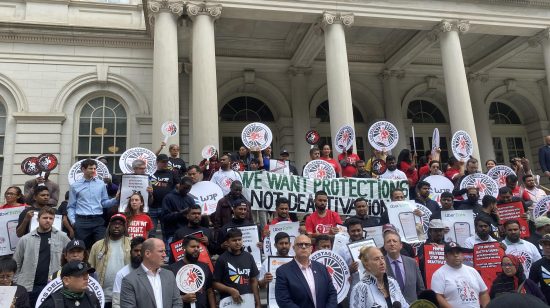
Deliveristas Rally for Deactivation Protections at City Hall
The threat of instantly losing their job at any moment for not going fast enough forces deliveristas to put themselves and pedestrians at risk, advocates say.