
The Political Fight for Southern Brooklyn’s Russian-Speakers
Little Russia’s residents are impacted by the affordability crisis like everyone else, but they are also deeply wary of socialism.


In the lead up to the New York City mayoral election, competing political camps are focusing on my community: the Russian-speaking diaspora of deep southern Brooklyn.
This week, a super PAC with nearly $2 million dollars in contributions launched a six-figure campaign targeting Russian-speaking voters to support Andrew Cuomo. In a last ditch effort to stop Democratic nominee Zohran Mamdani from likely victory, this initiative will try to pull votes away from Republican nominee Curtis Sliwa who won most of southern Brooklyn in his 2021 mayoral run. The PAC’s message claims that “a vote for Sliwa is a vote for Mamdani.”
Meanwhile, I’ve been energized by the renewed attention on southern Brooklyn from the left. The group Showing Up For Racial Justice (SURJ), which organizes working class white people, has been concentrating their efforts for weeks on outreach to this community in Sheepshead Bay and Brighton Beach. Through SURJ, other Russian-speaking canvassers and I have been doorknocking with multi-lingual campaign materials while wearing t-shirts with Zohran’s name in cyrillic letters.
Canvassing for a socialist in hostile “Trump territory” is no easy task. But we believe that Zohran’s style of politics can resonate across the city, including in the often forgotten neighborhoods of southern Brooklyn. As of October 30, we have conducted nine canvasses in which 55 unique canvassers participated in 100 canvass shifts and knocked on almost 1,400 doors.
From the USSR to Little Russia
In 1989, my parents immigrated from Ukraine to the U.S. as part of a larger wave of immigration of the 1980s and 1990s. Just like my family, many of those refugees landed in Sheepshead and Brighton Beach (known as “Little Russia”), and surrounding neighborhoods. They often came with no money, no English, and no degree that meant anything across the ocean. Although many relied on public assistance like food stamps and rental assistance, those beneficiaries will often now decry those same programs as giveaways to less deserving recent arrivals.
Canvassing for a socialist in hostile “Trump territory” is no easy task.
Many of those refugees were also Jewish, fleeing religious discrimination in their home republics. For them, the experience with socialism is deeply intertwined with anti-semitism. Jewish families like mine from the former Soviet Union are painfully familiar with the infamous “5th line” in Soviet passports, which explicitly marked them as Jews. This ethnic marker made it easy for the state to discriminate – barring many from jobs, education, and imposing travel restrictions. My parents, who were denied the ability to be publicly Jewish in the Soviet Union, were only able to have a traditional Jewish wedding under a chuppah after they moved to the United States.
Now, with growing attacks falsely claiming Zohran Mamdani is anti-semitic, they fear a return of everything they had left behind. Meanwhile, a generational divide is growing. Older immigrants are shocked and horrified that their children are knocking on doors for a Palestine-supporting socialist. The younger generation is desperate for change in a city they can no longer afford and an end to genocide.
A red wave across southern Brooklyn
Once a Democratic stronghold, southern Brooklyn has been reliably red over the past decade. Trump won significant swaths of the area in 2016, and his popularity only continued to grow in 2020 and 2024. At the local level, residents of Sheepshead Bay and Brighton Beach elected Councilmember Inna Vernikov in 2021–the same politician who brought a gun to counter-protest a pro-Palestinine rally at Brooklyn College and called Jewish leaders nazi collaborators for engaging with Mamdani. The PAC that is now calling for southern Brooklyn residents to vote for Cuomo also gave Vernikov over $50,000 for her City Council run.
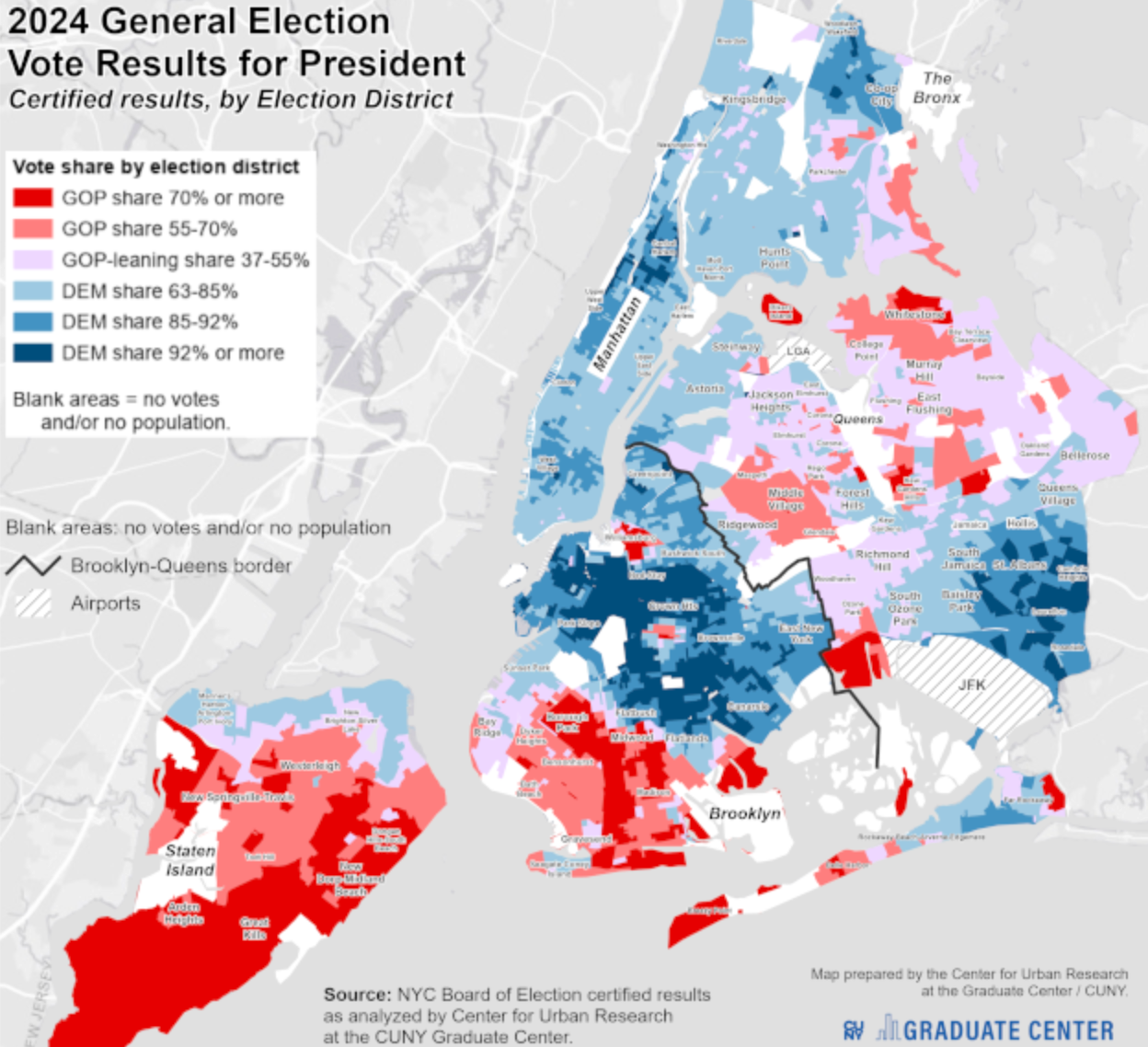
In Donald Trump and local-level proxies like Councilmember Vernikov, the Russian-speaking diaspora resonated with the messages of the right. Many believe that illegal immigrants are destroying the country (even if some of our own came through illegal means), that we risk the revival of a new Soviet Union, and that Republicans must block socialists from power before the country turns into what former Soviet immigrants escaped from.
When Assemblymember Zohran Mamdani’s campaign kicked into high gear, it became a lightning rod for some of the biggest concerns among the post-Soviet Jewish population of southern Brooklyn. Municipal grocery stores reminded them of breadlines and empty stores, and taxes on the wealthiest New Yorkers felt like a slippery slope back to Bolshevism. Zohran’s critiques of Israel and acknowledgement of its genocide in Gaza led to Islamophobic signs popping up around the neighborhood. No matter how many times Zohran repeats the same message – that he will be a mayor for all New Yorkers and create a Department of Community Safety that will address antisemitic hate violence – many continue to see his candidacy as a threat to Jewish safety.
The hopes and the uphill battles
It’s going to be an uphill battle to change the politics of southern Brooklyn, but fractures are emerging. In the Democratic primary, Zohran won over 70% of the vote in a few Brighton Beach electoral precincts. Those precincts are small blue islands in a red sea, but ones we hope to grow. The residents of southern Brooklyn are experiencing the cost of living crisis that many New Yorkers are feeling: housing, groceries, and childcare are squeezing their pockets too.
The Russian-speaking canvassers in Brighton Beach have been having mixed results in their canvasses: some doors slammed, scolding by babushkas sitting on benches, husbands holding their wives back from charging at our canvassers. But they also spoke to residents who were curious about Zohran. Others vaguely knew about the election but hadn’t had anyone knock on their door and were excited to talk about local politics with a volunteer in their native language. Along their route, a canvasser heard an elderly woman complain about long waiting times for the bus. The canvasser wished she had stopped to chat with the woman about Zohran’s plans for fast and free buses.
Those are the small signs of hope: that despite the misinformation, we can still reach people through Zohran’s economic agenda. I don’t expect the politics of Russian-speaking immigrants to change in one election cycle, but this campaign can be the start of a renewed hope for southern Brooklyn.
The Indypendent is reader-funded. We publish a free monthly newspaper, a website, a weekly radio show on WBAI-99.5 FM and more. To make a one-time or recurring monthly donation, click here.
Related Coverage
-

Mamdani’s campaign proved that democratic socialism can speak in a language of compassion and competence that resonates far beyond its traditional base.
-

With 2 Weeks Left in the Mayoral Race, Mamdani Hosts Cost of Living Classic in Coney Island
In addition to its stated goal of drawing attention to New York City’s high cost of living, the tournament also provided an opportunity for the campaign to activate supporters ahead of early voting, which begins next weekend.
-

Flailing Zohran Foes Wield Islamophobic Smears in Waning Days of Mayoral Race
Beloved Bed-Stuy Imam Targeted as Terror Suspect After Endorsing Mamdani