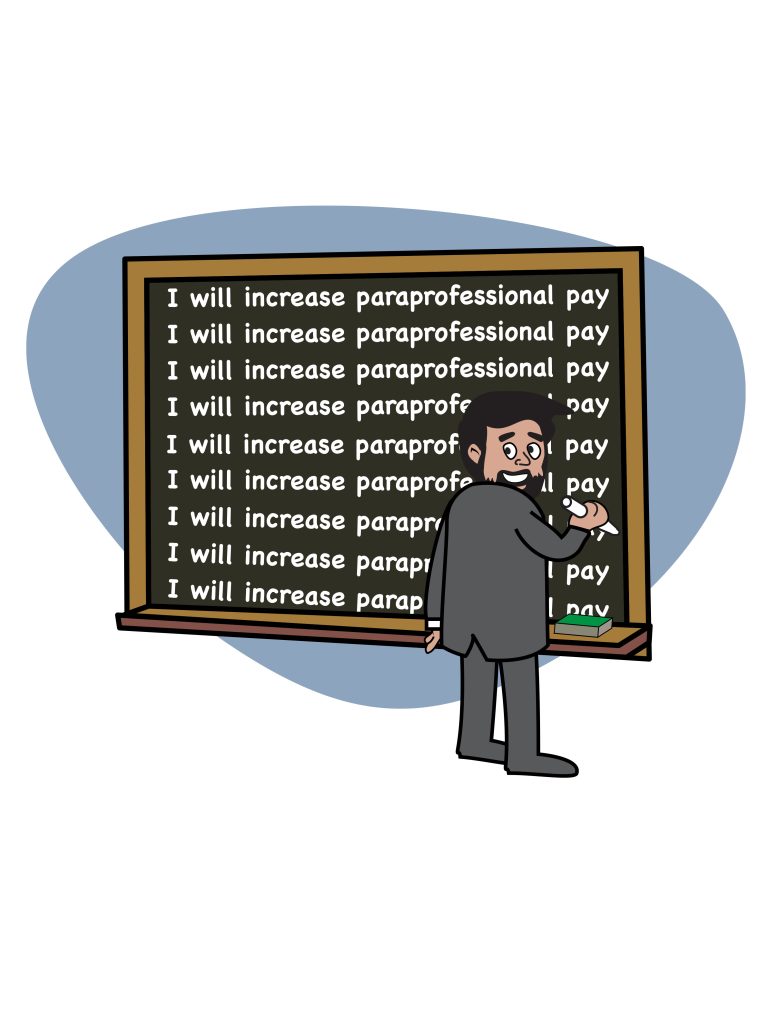
The Strange Politics of Giving Paraprofessionals More Money
NYC’s most under-paid educators got organized – and are now caught in a complicated political crossfire.

The fight over a one-time bonus for underpaid school workers has seemingly reversed the political dynamics of New York City in the Mamdani era.
On the side of the Respect Check bill, which would give paraprofessionals in city public schools a $10,000 bonus, are City Council Speaker Julie Menin, the centrist defender of the city’s rich from Mamdani’s attempts to raise their having their taxes raised, and United Federation of Teachers (UFT) president Michael Mulgrew, who has long treated paras as an afterthought. On the other side, the heralded socialist mayor Zohran Mamdani, who likes to shout out every working-class job and immigrant community in his speeches, is suing to block the bill, on the possibly legally valid but politically dubious grounds that giving paras a raise through legislation violates their collective-bargaining rights.
Most news coverage has focused on the political barbs traded by Mulgrew, Menin, and Mamdani, and that’s part of the problem. Because some of the paras whose organizing started this whole fight are concerned that neither side is responding to their actual needs and demands.
The city Department of Education (DOE) employs over 20,000 paraprofessionals, who provide individual support to students and general support to teachers. Despite their essential role, paras have historically been overshadowed by the city’s 78,000 teachers, both in the DOE and the UFT.
The starting pay for a full-time DOE paraprofessional is just $33,000 a year – less than a quarter of what Mamdani’s new True Cost of Living Measure estimates is necessary for a family with children to live “with financial security and dignity” in the city.
“Paraprofessionals are not seen as [having] a career,” says Alyson Monzon, who has worked as a para in Queens schools for over a decade. “That’s where the disrespect lies. Well what happens when you don’t have paras? Who’s there to help that one-on-one student?”
Marie Wausnock, who has a large social-media presence as “Marie Para,” is a founder of the Fix Para Pay caucus in the UFT. She argues that pensions are a critical issue. “Paras come in for their final consultation and they come out shell-shocked, saying “Oh my God, I’m going to work till I’m 80.”
The UFT estimates that this combination of hard work, low pay, and disrespect has led to there being nearly 2,000 para vacancies heading into this school year, a shortage that will strain everyone working in schools and especially affect the students most in need of individual support.
The Respect Check bill, passed unanimously by the Council in July, intends to boost paraprofessional recruitment and retention by giving out a $10,000 bonus in four installments over the first half of 2027. Mulgrew hailed the bill as a “historic” moment in which UFT paras “will finally get the respect they deserve.”
In fact, both Wausnock and Monzon see the bill as continuing a long history of disrespecting and not listening to paras.
How It All Began
The origins of the Respect Check bill aren’t from the longstanding crisis of low para pay and poor retention, but the more recent organizing done by the Fix Para Pay caucus: specifically, that in 2024, it defeated Mulgrew’s Unity Caucus in the UFT Paraprofessional Chapter election, winning 75% of the vote. In the full UFT elections the next year, Mulgrew and Unity squeaked by with only 54% of the vote, down from 66% three years earlier.
“Paras have been left behind for decades under Michael Mulgrew,” says Wausnock. “The ‘Respect Check’ was born because Fix Para Pay won a landslide election.”
Many inside the UFT believe that these two votes caused the UFT to dramatically shift its focus on its 22,000 paraprofessional members. “Paras have been left behind for decades under Michael Mulgrew,” says Wausnock. “The ‘Respect Check’ was born because Fix Para Pay won a landslide election.”
But while Fix Para Pay called for regular raises to be negotiated in the contract, the UFT which excluded many insurgent caucus leaders from the bargaining committee, watered down those demands — first to annual bonuses that wouldn’t count towards the pension, and finally to non-contractual legislation to give a one-time, non-pensionable bonus: the Respect Check bill.
Wausnock argues that a bonus won’t address the para shortage: “It’s supposed to be a retention bill, but it’s the opposite. People are going to take the job, get the 10k bonus for the first year and then leave after the second year. People are waiting to retire, they’re going to get the bonus and then retire when it’s done.”
While Wausnock opposes the “Respect Check,” Monzon is more ambivalent: “I certainly need it, as someone who struggles with rent, groceries, debt. But I also don’t want us to confuse temporary relief with permanent change. It doesn’t change our base salary, isn’t pensionable. My concern is if we get this raise in the contract, [the UFT] will say “paras got that bonus, so now just [a] 3% [raise] for them.”
The other way in which the UFT chose a different path from the one pushed by Fix Para Pay was to pursue money through Council legislation rather than the union contract. This is the conflict currently generating headlines, with Mamdani threatening to sue, arguing that the bill violates the Taylor Law, the state legislation covering public-sector unions.
Whether the city would win this lawsuit is unclear. Mark Kagan, a longtime public-sector union activist who served on one of Mamdani’s transition committees, is critical of Mulgrew’s actions but told the Indypendent that because the Respect Check bill came at the behest of a city union, it shouldn’t be found to violate legislation designed to protect unions from having antagonistic pay or other contractual matters imposed on them by legislation.
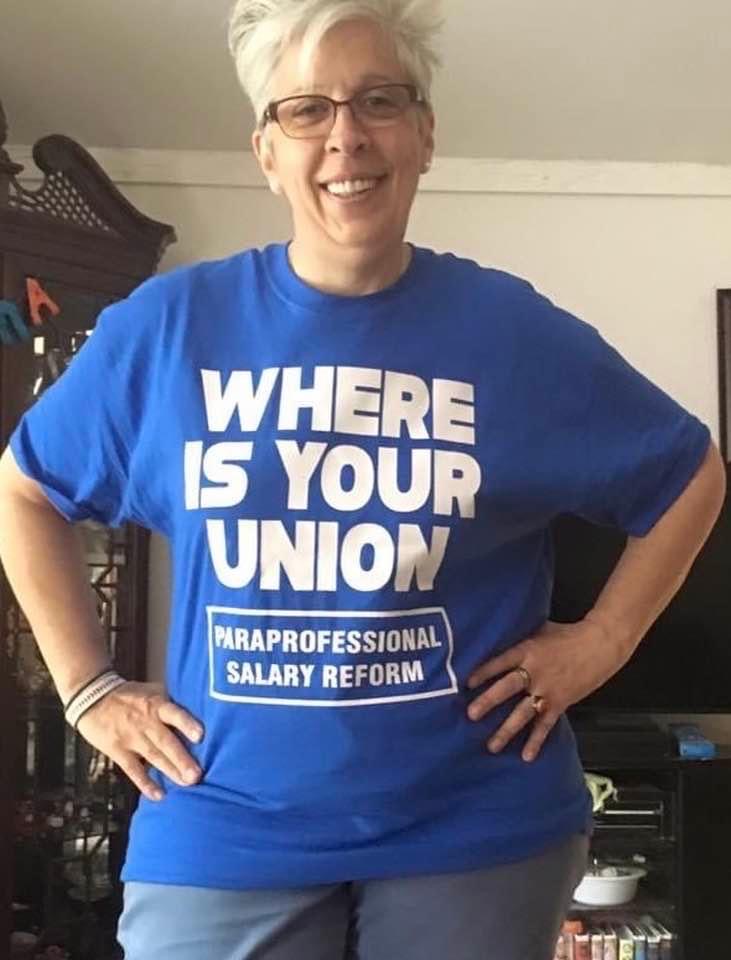
Regardless, this complex situation begs a simple question. If the teachers’ union wants raises for paras, and the socialist mayor says he agrees, why not just sit down and negotiate it into the next contract? This is exactly what Kagan recommended to Mamdani in a recent article in The Chief: “Tell the UFT you want to settle all money issues this fall and use that opportunity to get UFT president Michael Mulgrew to commit some of that money to front-load para wage increases.”
This is where we have to put on our bullshit detectors and look at the gap between what both the city and the UFT are saying and what they are doing.
Power But With Constraints
Mamdani is caught between the promises he made as a candidate and the budget he oversees as a mayor – a budget that is constrained by the very limited revenue increases he’s been able to win from Governor Kathy Hochul, his “most important ally” who has nonetheless blocked serious plans to tax the rich.
Even a socialist mayor is management for their city’s employees. In the city’s lawsuit against the Respect Check bill, the Mamdani administration sounds like the manager of a nonprofit grasping for progressive-sounding reasons to oppose giving a raise. Note how concerns about other workers asking for raises are pitched as respect for preserving collective bargaining:
“If the Paraprofessional Pay Bill is allowed to stand, other public employees will undoubtedly seek their own ‘stabilization’ payments from the Council, also outside of the collective-bargaining process, or otherwise use Council proposals for such payments as leverage over that process.”
If the teachers’ union wants raises for paras, and the socialist mayor says he agrees, why not just sit down and negotiate it into the next contract?
One red flag for those hoping Mamdani will do the right thing is the frequent appearance of the name Robert W. Linn in coverage of this issue. Linn, currently serving as an advisor to the mayor, was the architect of Bill de Blasio’s 2015 concessionary contracts with municipal unions, who had gone without contracts during Michael Bloomberg’s final term, rejecting Bloomberg’s stingy wage offers and demands for cuts in pensions and health benefits. Those contracts, which consisted of below-inflation raises and health care “savings,” contributed to the affordability crisis that Mamdani campaigned about a decade later. (The pattern of finding health care “savings” continued under former Mayor Eric Adams, when retirees were forced into for-profit Medicare Advantage plans)
Then there is Michael Mulgrew, who claims that the UFT has been held back from winning major raises for paras in the contract by pattern bargaining, the longstanding practice in which the city’s unions negotiate roughly the same pay increases. According to this logic, it’s impossible to win a major raise for paras without the city’s other (mostly higher-paid) workers getting an unrealistically similar boost.
While many labor activists would be happy to see their unions ditch pattern bargaining, which often functions as a way for unions to avoid accountability for inadequate contracts, longtime Unity critics inside the UFT argue that in this case it’s a flimsy excuse.
Shortly after Fix Para Pay’s chapter victory in 2024, UFT member Dan Alicea noted that the union had a chance in its previous contract to direct up to $450 million in unexpected revenue towards its paraprofessionals.
“Had Mulgrew unilaterally decided,” he wrote on Substack, “to allocate it to paras because of the shortage, no one would have blinked. Rather, after the deal was reached he argued that equal payments to all titles was ‘equitable.’ This shows his fundamental disconnect as to what equity truly means… Ultimately, Mulgrew lacked the vision, union values and will to place paras first, and failed to equitably give them the lion’s share of that $450 million.”

Two years later, the union leadership was trounced by Fix Para Pay, and has been looking to shore up its support among paras ever since. It found a key ally in Democratic moderate Julie Menin, whose Council speakership it heavily invested in last year. For Menin, widely viewed to be eyeing a future mayoral run against Mamdani, the issue of para pay is a way to score labor points against him – and counter her image as the defender of Hamptons wealth.
All of which has brought us to this confusing point, in which a conservative Democrat and a machine union leader are fighting against a socialist mayor to win money for some of the city’s most exploited workers.
Mamdani & City Workers
On Sept. 7, Mayor Mamdani announced the Mayor’s Office of Worker Power, which Politico reports will conduct “hearings to gather information from workers about conditions in various industries while connecting participants across sectors.”
It’s an exciting new Initiative for private-sector workers, which raises the question of what Mamdani is proposing for the public-sector workers that he is directly responsible for. In a recent article for Vital City, labor historian Joshua Freeman notes that Mamdani’s innovative initiatives have so far largely passed over the city workforce; he has retained Eric Adams’ head of the Office of Labor Relations.
Kagan believes that Mamdani’s focus on working-class issues has focused more on New Yorkers as consumers than as workers. Proposals for free buses and rent freezes are important measures that address expenses, but not how workers can increase their rights and power on the job. “These are the workers under his control,” he says. “They could tell agency commissioners you have to meet with your sanitation workers, your health workers and talk about how to fix problems in the workplace.”
Marie Wausnock agrees. “I want to meet with the mayor, meet with his team, [so he can hear] not the Kool-Aid version Michael Mulgrew sells to people.”
As the fate of the Respect Check bill sits in court, Monzon is focused on the organizing it will take to win actual respect for paras. She says that she created a survey for her colleagues to find out their main concerns: “The base pay, pension improvements, respect, a stronger voice in our unions. I didn’t tell paraprofessionals what they needed, I asked them. That’s what I want to highlight, that no one in the current union leadership asked us.”
“I want the check,” she concludes. “I just don’t want the check to become the solution.”
Related Coverage
-

Homecare Workers Fighting Against 24-Hour Shifts End Second Hunger Strike
Homecare workers on their second hunger strike this year as a bill that would shorten their day-long shifts stalls.
-

Black Harlem Workers Have Historically Helped Lead the Labor Movement
Let’s rebuild that tradition today.
-

With AI Booming, Corporate CEOs Are Bragging About Their Mass Layoffs
It’s all about boosting shareholder value as the traditional compact between employers and employees disintegrates in front of our eyes.