Inside One of Gaza’s Internal Displacement Camps
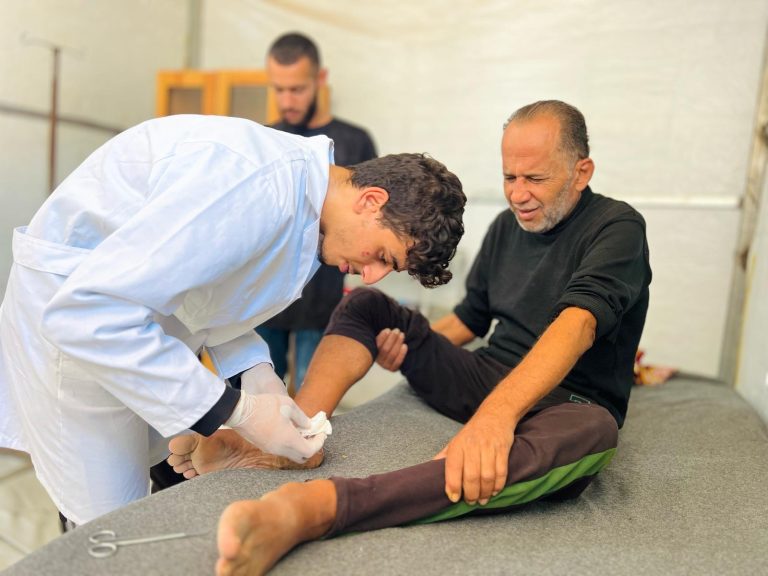
The Refaat Alareer camp has become a relatively safe place for some of Gaza’s most severely ill and injured residents, but it still can’t protect people from Israel’s violence.

When Israel was founded in 1948, at least 750,000 Palestinians were expelled from their soon-to-be erased towns and villages. Many of those fleeing the Nakba who lived in what is now southern “Israel” ended up in the Gaza Strip. They settled in refugee camps that eventually became towns and small cities. Since Israel’s genocide began in October 2023, Gaza has been mostly obliterated. Amid the ruins, internal displacement camps have formed, often with hundreds of tents and dire conditions. Theft and violence is common at some camps, say people familiar with the situation.
“People are starving,” says Hala, explaining the tension at many camps. Hala is one of the founders of The Sameer Project, a grassroots aid group that works on the ground in Gaza and founded the Refaat Alareer camp, which has become a relatively safe place for some of Gaza’s most severely ill and injured residents.
‘The Refaat Alareer camp is not in any way a benchmark of how camps are’ generally in Gaza.
But it still can’t protect people from Israel’s violence. “In August a quadcopter came down to our camp,” says Hala, explaining that quadcopters have cameras on them so they can see what or who they’re targeting. “They shot a little girl, Nour, in the leg.” The Sameer Project evacuated the whole camp from Salah al-Din to Zawaida, both neighborhoods in Deir al-Balah, central Gaza — the last (somewhat) standing city in the Strip.
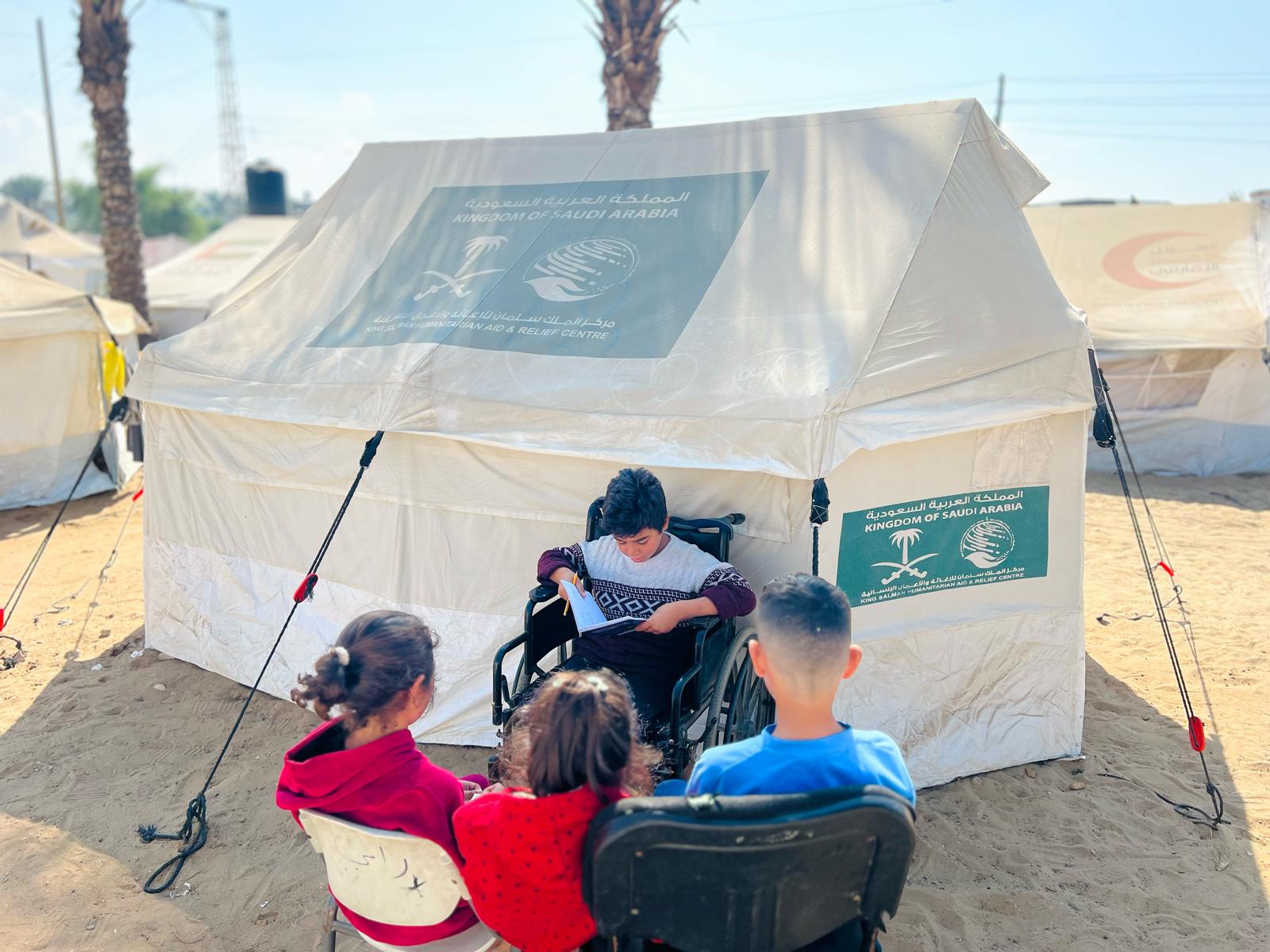
The Refaat Alareer camp hosts 22 tents and around 120 people including staff. It has grown since it started with three or four families and hopes to continue to if it can garner enough donations. It provides clean water to its residents and has a strong security system with five hired guards. There is a medical station where nurses are always available. The camp has internet service and offers classes to children five days a week, including one art day. There are volleyball courts. And trainings that meet a variety of needs. A gynecologist gave an information session; someone came and held a lesson on breathing techniques; there have been bomb-response trainings for children.
The Sameer Project
Camp residents spend time going to the clinic, attending various organized events and school, socializing with each other, and cooking. There are small fireplaces scattered around the camp so each family can cook. The Sameer Project gives people a weekly allowance “so they can buy some basics like a bag of rice, flour, oil.”
But less and less food has been allowed into Gaza this fall. “The community kitchens around the camp all closed in the last few days due to a lack of supplies,” said Hala in mid November. “Food has been a huge difficulty over the last month.”
There has also been a shortage of medicine since the onset of the genocide, when Israel immediately started cutting off the regular supply of resources trucked into Gaza. But the shortage has become extreme in recent months.
“We don’t have any medication,” says Hala. “No aid is getting in; no trucks are getting in. … Even the larger organizations barely have enough.”
According to The Sameer Project and recent news reports, even for the mere dozens of trucks per day that have been entering Gaza — an all-time low — the Palestinians there are seeing little of the aid, and when they do, it’s priced very high.
“The occupation started to hire gangs to rob the trucks, put the materials in storage rooms, trickle down the aid and make sure it’s priced really high.” When people try to go stop the looting, quad copters come down and shoot them, Hala told The Indypendent. “So everyone knows that gangs and traitors are working with Zionists.”
• • •
Hala is a London-based Palestinian whose parents are from Gaza. The father of her cousin Mira, who also helps run The Sameer Project, chose not to evacuate from Gaza and subsequently died there, hence the name of the group.
“When the genocide started,” Hala recalled, “for the first couple of months we were focused on the survival of my mom’s family members, and then a lot of them evacuated in December, so that’s why I started working on mutual aid.”
The Sameer Project’s first efforts were focused in Rafah, Gaza’s southernmost city where more than a million Gazans had taken refuge after Israel marked it a so-called “safe zone.”
The Refaat Alareer camp hosts 22 tents and around 120 people including staff. It has grown since it started with three or four families and hopes to continue to.
“We started a small group in April. We thought this was going to be like a month or two. We didn’t have the expectation that the world would watch a genocide go on for over a year,” Hala said, adding, “We work very closely with people on the ground. We don’t consider ourselves the leaders of The Sameer Project; we consider ourselves the facilitators, but the people on the ground know what’s happening.”
Through family connections in Gaza, Hala learned safe tents were one of the greatest needs in Gaza. She began purchasing them on an ad-hoc basis from local vendors. The Sameer Project paid $850–$1,000 per family to cover the cost of a tent plus some cash aid and currency-exchange fees. Thanks to fundraising campaigns promoted by a popular Instagram page, Translating Palestine, whose founder is one of the members of The Sameer Project, the group raised $500,000 in May and June.
“Because we’re a mutual-aid group, we’re able to bypass [red] tape some NGOs have, find the best exchange places to get best exchange rates and withdrawal fees and to buy tents in bulk from merchants,” said Lena Dajani, another founding member of The Sameer Project who is a Palestinian-American living in Southern California.
Groups abroad can send wire or crypto transfers to the people that run the exchange businesses. Because all the banks closed at the beginning of the war, the people who run these exchanges charge extra fees.
• • •
The Sameer Project was forced to flee Rafah in May when Israel invaded and leveled the city.
“A million people all within three days were trying to run north while they were getting bombed,” Dajani told The Indy. “People were going to al-Mawasi and Deir al-Balah,” so the group followed them.
“We noticed lots of ill and injured people were out in the streets; we saw a need for medical services, especially for adults who aren’t served by NGOs,” said Dajani. The group put together a team of doctors and opened what it initially planned to be a camp for expectant mothers, but the doctors couldn’t ignore all the people with other medical needs they were encountering: “People that needed war injuries changed, patients that were awaiting evacuation and would be discharged from the hospital” with nowhere to go. “Now we only serve the most vulnerable medical cases,” said Lena.
“The Refaat Alareer camp is not in any way a benchmark of how camps are” generally in Gaza, says Hala. The camp is small, with most others averaging 200–300 tents, she says.
There are some camps run by aid groups, like the Palestinian Red Crescent, that have access to clean water. “Other camps are like slums,” says Hala, “random sporadic tents set up next to each other.” Usually a group of people from those camps creates a leadership committee, and the camps each have a small medical station where a doctor volunteers.
The Sameer Project recently started communicating with a point person from around ten high-need camps so it can start to provide them with aid like food, water trucks that will last a few days, tarps, blankets, cleaning supplies and adult diapers.
The Indypendent is a New York City-based newspaper, website and weekly radio show. All of our work is made possible by readers like you. During this holiday season, please consider making a recurring or one-time donation today or subscribe to our monthly print edition and get every copy sent straight to your home.
Related Coverage
-

Palestinian journalists in Gaza have been killed at a historically high rate in the past year. The remaining journalists in northern Gaza have been put on what amounts to a kill list.
-

Israel seeks to choke off Gaza’s only portal to the world.
-
 The Refaat Alareer camp has become a relatively safe place for some of Gaza’s most severely ill and injured residents, but it still can’t protect people from Israel’s violence.