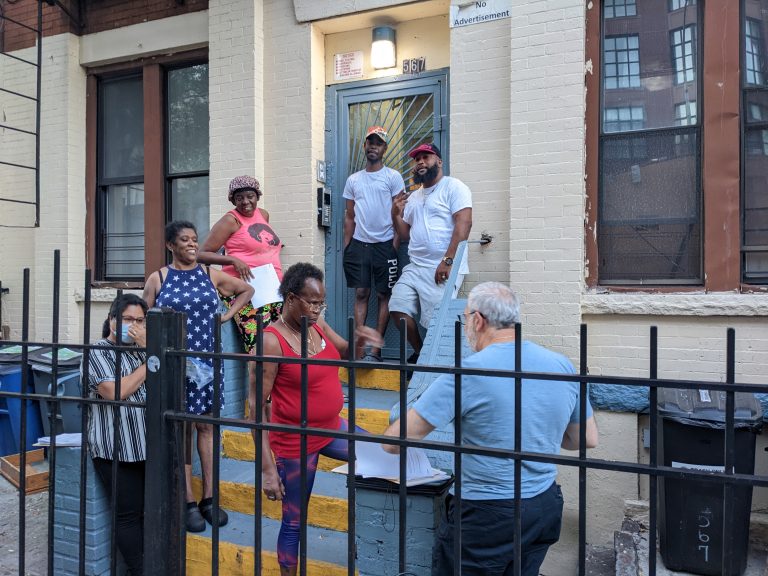
When Tenants Unite
Residents at 567 St. John's Place Savor Partial Victories, Demand More.


In 2021, after decades of living in horrible conditions, the tenants of 567 St. John’s Place in Brooklyn felt like they had finally won — the city sided with them in court and took control over the building away from their slumlord. The court granted their petition for the building to be put into the city Department of Housing Preservation and Development’s 7A program, in which a court-appointed administrator is in charge of collecting rents and making repairs.
But, three years after winning their case, the tenants are still waiting for their living conditions to improve. “Anything you can think of, 567 St. John’s has experienced it,” tenant Evelyn De Leon told The Indy. “Uneven floors that make walking dangerous, constant bedbug and rat infestations, collapsing ceilings, damaged outlets, leaking pipes, and apartments without proper stoves or fridges.”
The four-story, eight-unit building currently has 477 open violations listed on HPD’s online database, including 87 Class C — “immediately hazardous” — violations such as mice infestations, crumbling ceiling plaster, and lead paint. The building sits half a block west of Franklin Avenue in a rapidly gentrifying part of Crown Heights. The apartments are rent-stabilized, but the tenants’ previous landlord, Gerard Tema, had been illegally overcharging them.
One tenant, who wished to remain anonymous, moved in five years ago, and said he had been paying $500 more than his legal rent. It’s become a part of the playbook for landlords of rent-stabilized units to push tenants out by letting the building and units fall into disrepair, flipping the units, and then renting them to new tenants at much higher rates.
But these tenants aren’t budging.
Residents in seven of the eight apartments began organizing in 2013, after their stairway collapsed and was left unrepaired for six months. The state Department of Homes and Community Renewal lowered their rents to $1 later that year. One tenant, who also wished to remain anonymous, said Tema lied to her, saying the rent had reverted to its original rate, so she paid him thousands of extra dollars in rent. “I already bought my apartment with that rent,” she said.
The tenants became affiliated with the Crown Heights Tenant Union in 2019 and went on a rent strike. They and CHTU, with the support of the Legal Aid Society, filed a 7A case in the winter of 2021. Article 7A of the state Real Property Actions and Proceedings Law, enacted in 1965, allows private tenants or HPD to ask Housing Court to appoint a city-approved administrator for a building that has conditions “dangerous to the tenants’ life, health and safety” for at least five days. The landlord remains the owner, but the building stays in the 7A program until a new buyer comes in or the landlord proves they can maintain it in habitable condition.
After over a year of litigation, the court sided with the tenants and removed Tema from control. The tenants, given a limited list of candidates, selected Nikolaos Leonardos to be administrator for the building in June 2022. Leonardos received a 7A Financial Assistance (7AFA) loan of $1,053,965 to help him carry out the repairs ordered by the court. Those loans, which are billed to the property, are rare: Only 24 have been issued in the 7A program’s history. Following face-to-face negotiations with Leonardos starting in August 2022, the residents got their illegal rent overcharges rolled back, and got the wheels turning on their renovation demands. But the renovations, which started on the first floor, did not begin until the spring of 2025. They are still unfinished.
One tenant said Leonardos is pressuring them to temporarily move out of their units, claiming that their presence is causing delays in the renovations. But the tenants had struck a deal with the city that no one else should have to temporarily relocate until the first tenant who did so returns.
That tenant, Betty Nazaire, moved from her first-floor apartment to Bushwick in the spring of 2025. She has been unable to return home, as deadlines for finishing the renovations on her unit keep passing. The tenants said they anticipated these delays and wanted the city to pay compensation for them, but the city refused. One tenant noted that Leonardos has not communicated with the tenants about construction times, or when the water needs to be turned off for the work. With the 7AFA loan, the tenants stressed, he has the money to get the renovations done: He just needs to arrange them.
As a 7A case, the building’s future is uncertain. CHTU cofounder Joel Feingold said at least three potential buyers had expressed interest after seeing it listed for sale by Tema, but they backed out after seeing the million-dollar liens on it, which any new owner would have to pay. Natasha Kersey, HPD’s deputy press secretary, said that the “tenants are not in limbo,” because the administrator “actively manages the building and oversees rehabilitation work” until “a responsible owner demonstrates the capacity to manage it.” But what happens if no one else wants to buy the building, and Tema can’t prove he can maintain it?
“We’re at a really important crossroads in the history of New York City, and potentially at a really important crossroads in how we conceive of solutions to the housing crisis,” Feingold said. Mayor-elect Zohran Mamdani has promised tenants in rent-stabilized apartments that he’ll freeze their rent as mayor. His platform also states that, in extreme cases of neglect by landlords like the owner of 567 St. John’s Place, the city would “take control of their properties,” and utilize the 7A program more.
The program, which came into widespread use during the massive housing abandonment of the late 1970s, is rarely used today. As of January 2025, only 26 buildings, with a total of 204 units, were in the program, HPD said then. In 1981, it oversaw more than 300 buildings, and in 2003, there were 123, according to a report by the Independent Budget Office that year.
But Feingold envisions something more than just the city stepping in with the 7A program and eventually selling the building to a different landlord. The model mayoral administrations have used since the 1980s to create supposedly affordable housing has been offering subsidies to private companies for building below-market-rate units. Feingold is urging Mamdani to listen to tenants, like those at 567 St. John’s Place, who want control of their building’s future after the city takes it over from neglectful landlords.
“It would be a real tragedy and an avoidable tragedy for the Mamdani administration to pursue a strategy that is more of the same,” Feingold said. This new model of public housing, Feingold explains, would remove neglectful or big corporate landlords, and turn the buildings over to a streamlined public agency that has an elected tenant leadership. That way, tenants would still have control over their own living conditions and rents. This new agency, he said, would need to work with or even be a part of the New York City Housing Authority, so as not to create separate, unequal systems.
Until then, the tenants of 567 St. John’s Place hope that the renovations will be completed soon, so they can finally reap the benefits of their victory in Housing Court three years ago. “We invested so much in this building. If we walk away, we lose everything,” one tenant said.
“The residents of 567 St. John’s Place deserve better,” De Leon wrote. “Real action, transparency, and a safe, livable environment, not another year of false promises and unfinished work.
The Indypendent is reader-funded. We publish a free monthly newspaper, a website, a weekly radio show on WBAI-99.5 FM and more. To make a one-time or recurring monthly donation, click here.
