
NYC Gets Ready for ICE
We are cobbling together this resistance from thousands of small gestures and actions, one poster in a window, one banner on the garden fence, one meeting of neighbors, one meal hand-delivered, one detention we helped someone avoid.

This is a story about how I became a resister, joining with thousands around the country to stand against Trump’s mass deportation plan. The mutuality and inclusivity I’ve experienced since I’ve gotten involved in helping to protect my neighborhood from ICE has lifted my spirits and rekindled the hope that, if we keep at it, we can turn the authoritarian tide and build a more progressive and caring world in its wake.
I attended my first Know Your Rights (KYR) training in mid-November in Kensington, a neighborhood in Brooklyn not far from my own. The workshop took place in a large apartment building off a busy street. A volunteer met me in the lobby and pointed me toward the host’s apartment where nearly 20 people were crowded into the living room. We were young and old, experienced organizers and first-timers. About five other residents from the apartment building were meeting each other for the first time. A few came because they saw a flier in the building’s lobby. I had heard about the workshop through Hands Off NYC, a coalition of over 100 labor, religious and community groups that formed in October to protect the city from escalating ICE raids and the threat of federal intervention. This was one of 60 events taking place across the city that day, all under the Hands Off umbrella.
Our host, a vibrant middle-aged woman whom I’ll call T., was an elementary school teacher in Sunset Park, a largely Hispanic and Asian Brooklyn neighborhood. The area is one of several known epicenters of the ICE raids now taking place in NYC. On a table in front of T. were piled packs of silver whistles on colorful neck strings, palm-sized KYR cards, stickers with a number to call “If You See ICE,” and an array of political buttons including one that simply said “People Power.” There were also art supplies—paper clips, scissors, markers, hole punchers. Later we would use every available surface in the apartment to turn stacks of 8 1/2 x 11-sized leaflets describing how to report ICE in both English and Spanish into pocket-sized zines. We’d also attach instruction cards to each whistle so that people would know how to use them during a raid.
T. began by asking each of us to give our name and, if we could, a word or two describing what gave us joy in resistance. The question felt inappropriate, even a little upsetting. What was there to feel joy about when federal agents were disappearing people with impunity? A vision went through my mind of ICE agents in Chicago, who, in a midnight raid just weeks before, had rappelled out of helicopters into an apartment building that looked quite a bit like the one we were sitting in now.
I hadn’t allowed myself to feel how much hurt I was in for my neighbors, my city, and my country.
As we went around, people mentioned the music and inflatable costumes at demonstrations. Most, though, said it was knowing that there were others also standing up that gave them joy. I was close to tears by the time my turn came. For me, too, it was being with people who were willing to stand up and to support and take care of each other. I hadn’t allowed myself to feel how much hurt I was in for my neighbors, my city, and my country. The thought that I could lean on people I had just met and they, in turn, could lean on me, brought those repressed feelings to the surface, but it also brought one I hadn’t expected: I felt braver.
Like just about everyone I know, I have felt overwhelmed and depressed since Trump’s re-election. My spirits have been buoyed every time I’ve attended one of the coordinated, nationwide demonstrations, especially as the number of people taking to the streets has grown to record-breaking numbers. Still, in between demonstrations, I have struggled with high levels of anxiety and a feeling of paralysis akin to when you are watching a horror movie. Almost a year into the Trump regime, everyone I knew was saying we have to speak out, that that’s the only way we can protect each other and our democracy, but quietly I had begun to pull in as the repression had gotten more and more extreme. I could feel myself succumbing to fear, thinking twice, for example, before signing a petition and, truth be told, sometimes deciding not to sign at all.
I learned later that T. had also been feeling depressed and helpless as she watched events unfold in Sunset Park. Since summer, a number of children in her school have lost a parent to ICE. One second-grade boy stopped talking after his father was taken. When a fifth grader’s father was taken as he was walking the boy to school, the whole school was traumatized. When T. heard that Hands Off was calling for people to host workshops, she decided to sign up, even though she was “just an individual,” not an organization like other hosts. She got up to speed by watching every video on the Hands Off website. Now she would share what she had learned with us.
“We are so lucky here in New York to be able to learn from the experiences of the resisters in L.A. and Chicago” T. told us, holding up a zine titled “How to Report Ice.” It’s marked “NYC Edition” but most of the text was created by people in Chicago during “Operation Midway Blitz,” the government’s catchy name for the brutal surge of ICE agents there. One of our tasks, as we assemble the zines, will be to change the Chicago phone number for reporting ICE to NYC’s Hotline: 229-304-8720.
The resisters in Chicago also came up with the whistle protocol we now use in NYC: short broken bursts to warn people that ICE is nearby so that vulnerable people know to get inside, stay inside, or move out of reach, and long continuous blasts if someone is being detained, a sound used to summon less vulnerable people to protest and stand witness to what federal agents are doing.
Even more than the materials and techniques, T. emphasized, the most important gift people in Chicago and other targeted cities have given us is the inspiration of their courage and resourcefulness.
The most important gift people in Chicago and other targeted cities have given us is the inspiration of their courage and resourcefulness.
On Nov. 29, two days after Thanksgiving, that courage was on display in NYC when “citizen activists,” as The Guardian later called them, noticed ICE vans and dozens of federal agents in a parking garage on the edge of Chinatown staging for a raid. They called the news in to the ICE Hotline, and the word spread throughout the network of rapid response Signal groups that have sprung up across the city. About 200 New Yorkers made their way to the site and, blocking the entranceway with their bodies, metal barriers, and garbage bags, kept the vehicles trapped in the garage for over an hour. When the vehicles eventually made it out, activists chased them down Canal Street. Soon their license plate numbers appeared on Signal chats around the city, alerting others.
Later that day I ran into a young friend who had taken part in the protest. “We didn’t stop them,” she told me, sounding a bit discouraged. “They still went off to kidnap people.” The next day, however, Time Magazine reported that the ICE vehicles she saw driving off were headed to the Holland Tunnel to exit New York: the protesters had stopped them, at least for that day.
This close to the action, it’s hard to know what effect we are having. We are learning as we go. So, too, is ICE. Since the two massive surges attempted in Chinatown (the raid on Nov. 29 had been preceded the week before by a surge of 50 federal agents with armored trucks which demonstrators had also disrupted) there have been no more showy raids in NYC. Instead, ICE has fallen back on quieter tactics.
In Sunset Park, for example, where there’s been a big uptick in abductions since November, ICE agents patrol between six and eight in the morning. That’s when people who work in the service or construction industries—job sectors where immigrants often predominate—are making their way to work through empty streets. Early morning is also the time when parents are walking their children to school. The raids have been quick, over before anyone who might come out to witness or protest the abduction even knows it is happening. This tactic is making it hard to know how many New Yorkers ICE is taking or even where, in our immigrant-rich city, federal agents are concentrating their attacks.
In response, community members have ramped up early morning patrols, though they refer to them as ‘care walks,’ in an effort to replace militaristic-sounding language with a term that more accurately reflects their values. In some neighborhoods, inspired by what parents did in Charlotte, North Carolina during the surge there, people position themselves along major routes, creating safety corridors for anyone walking to subways or school in the mornings. These tactics seem to be working. If anyone whistles, one organizer in Sunset Park told me, ICE will often leave: “They don’t try to push through whistles.”
We are learning as we go. So, too, is ICE.
But tactics are not static. In mid-January, federal agents suddenly changed their routine, carrying out raids in the afternoon and early evening when resisters weren’t expecting them and a number of people were abducted.
In the fall of 2024, the historian Timothy Snyder did a thought experiment, imagining what Trump’s plan to deport 10 million people would look like on the ground. “This will involve people you know,” he warned on his Substack. He predicted the policy would pit people against each other in a way that would change the country “dramatically and for the worse.” Just weeks before the election, Snyder was clearly trying to motivate people to vote against Trump. Listening at the time, it made me wonder: would people really turn on each other or would they, as often happens in a crisis, put aside narrow self-interest and come to each other’s aid? One year on, I think we are beginning to get the answer: the American people are just not having it. Instead of driving us apart, Trump’s deportation effort seems to be driving us together and making our communities stronger.
The growing power of the movement against Trump’s deportation plan lies in the many ways there are to get involved. Not everyone needs to stand on a street corner with a whistle. Each person who joins a resistance group brings their own unique skills and contacts and each group comes up with a plan of action based on the abilities of its members and their collective knowledge of the neighborhood. Groups are teaming up with long-standing mutual aid groups, food pantries, and churches to bring food and other necessities to people afraid to leave their homes. A group in Chicago has been buying out local food truck vendors early in the day and distributing the food themselves, so that the vendors, often immigrants, can quickly get off the streets. When a lawyer—not an immigration lawyer—joined a group in Brooklyn, he put together a list of immigration lawyers that immigrants, unsure of whether their own legal advisors were making legitimate suggestions, could contact to get a free second opinion. Another group in Brooklyn is creating a zine that details what to do ahead of time—organize documents, create a childcare plan—in case you or someone you love is abducted.
The growing power of the movement against Trump’s deportation plan lies in the many ways there are to get involved.
One area of work beginning to loom large is addressing the staggering psychological and economic distress ICE abductions leave in their wake. Often it is the breadwinner who is taken on their way to or at work, leaving the rest of the family not only emotionally traumatized, but also struggling to pay for rent and food, let alone any legal fees or court bonds they may now need to raise. Go Fund Me drives can only go so far in what are often poor and working-class neighborhoods, so community groups are helping families figure out other ways to bring in money. If the remaining adults in a household can make empanadas or provide childcare or cleaning services, for example, groups try to connect them to members of the community that can pay for those services.
“Showing that people are not alone is a huge part of aftercare,” one organizer told me. It’s not always easy, though, in a big city like New York, to help the folks left behind. The fear and traumatization levels are so high in vulnerable communities that residents in apartment buildings that have suffered losses to ICE can be leary of opening up to outsiders offering help. Sometimes it is only when a trusted community member steps forward that the gap can be bridged and support can flow in.
The hyper-local nature of these actions necessitates that people get involved, sometimes on a daily basis, with others in their community. In the process, we are building a network of compassion and commitment to core values of justice and democracy which may well outlive the current crisis. Some observers, including the sociologist Maria J. Stephan, see this movement to protect ourselves and our neighbors from ICE as laying vital groundwork for the kind of citizen actions we will need to protect our elections next fall from manipulation by Trump and the federal government. Ezra Levin, Co-Executive Director of Indivisible, writing supporters in early February to announce March 28 as the date of the next No Kings demonstration, is thinking along the same lines: “To defeat fascism,” he wrote, “we’re going to have to marry the breadth of No Kings mobilizations with the depth of organizing we’re seeing in the Twin Cities.”
The weekend following the thwarted raid on Chinatown, Hands Off began holding four-hour mass KYR trainings in every borough. So many people signed up for the one in Brooklyn, they had to cap attendance at 1,300. During the workshop, people broke into neighborhood groups to discuss how to organize in their particular communities. Hands Off Signal chats were formed for each neighborhood and a few days later I was able to sign up for the one covering mine. The welcome message explained the chat could be used “for discussion, community building, organizing, and rapid response” and included the warning, “This chat is not fully vetted, so be mindful of what you say. Do not share personal details, or say anything you would not like read back to you in court.”
We are building a network of compassion and commitment to core values of justice and democracy which may well outlive the current crisis.
I’m a member of a local community garden which got its start over a decade ago when neighbors came together to clean up an abandoned lot. Located in the “Little Caribbean” part of Flatbush, we are a diverse group with a listserv that is approaching a thousand people. We grow food communally, run a neighborhood food scrap drop-off program, and host arts and educational events including a children’s summer camp. We are what sociologists sometimes call “a third space”—neither home nor work, the garden is a place where people from different walks of life can meet each other, a place where community is being grown right alongside the plants. So, it made sense that in early December someone on our garden listserv raised a question about what we could do to protect our neighbors and our neighborhood from ICE. Remembering that T. had had no prior experience when she hosted her workshop, I decided to take the plunge and, after first making sure that garden leaders were in agreement, put out a call for garden members to come to a KYR workshop at my house.
With barely a week’s notice and two weekends before Christmas, 35 people showed up. The first big snow of the season had just blown in and people arrived in boots and big winter coats. Our workshop coincided with Hands Off’s second big weekend of community action, and we were listed as one of 120 events being offered across the city.
We were already expanding our boundaries, becoming more than just garden members; folks had extended the invitation to neighbors and friends. One garden member brought her daughter, an immigration lawyer. Amanda, a member of our compost team whose day job is designing KYR materials for the American Friends Service Committee (AFSC), had volunteered to run the workshop.
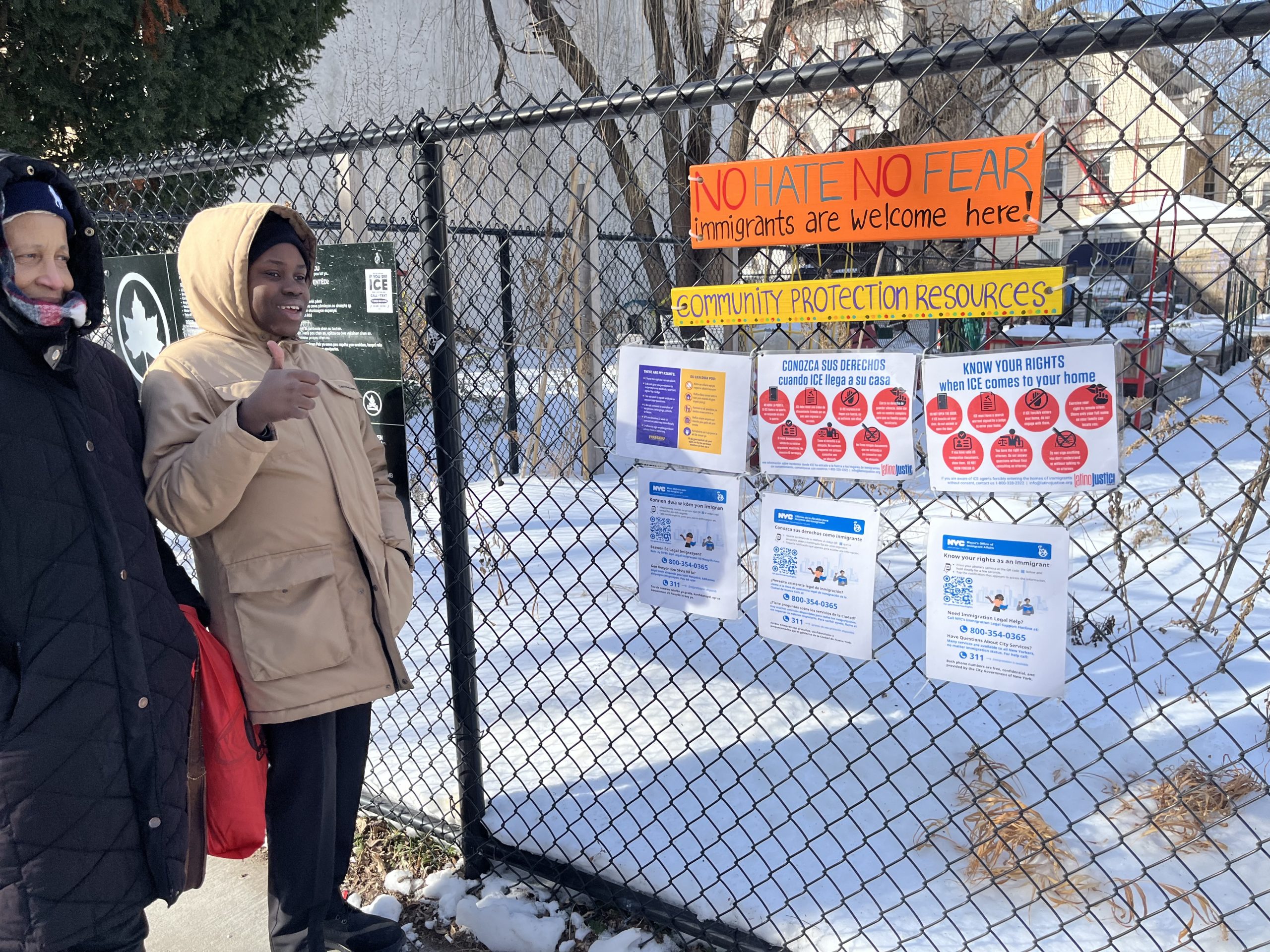
After Amanda’s presentation, we brainstormed what our garden community could do. People pointed out that there are longstanding groups already doing powerful immigrant support work in the neighborhood including Caribbean equality groups, tenants unions, mutual aid groups, churches, and, more recently, rapid response ICE watch groups that were already patrolling. We agreed that we needed to learn more about these groups and find ways to support and dovetail our work with theirs. We brainstormed other ways the garden could help, considering how our unique space could be used to help support, inspire, and educate people. We agreed we wanted to use our sidewalk-facing fence to post information the community can use, and we made a plan to meet again as a whole group after the holidays.
The following weekend, on the Saturday before Christmas, we held our first tabling event. We set up on the sidewalk just in front of the Garden. It was so cold that the eight of us were bundled to the max. Someone had brought hot chocolate to share. Inside the garden, the compost team was celebrating the end of their season and neighbors were coming by to drop their food scraps off for the last time until we reopen in the spring.
We had heard from other groups that the whistle kits would be a great draw and it was true: nearly every passerby stopped to find out why we were handing them out and stayed to talk about the situation with ICE. We quickly discovered that it was a two-way street: we learned, as we talked to people, that there had already been a number of ICE raids on nearby businesses—mostly food establishments over on Nostrand Avenue. One person reported seeing ICE agents walking up and down the same street asking for people’s ID. Until we tabled, we didn’t know what was happening just blocks from our garden. We had discussed at our first meeting the need to get KYR information to local business owners and workers. Now that effort would rise to a top priority.
We are cobbling together this resistance from thousands of small gestures and actions, one poster in a window, one banner on the garden fence, one meeting of neighbors, one meal hand-delivered, one detention we helped someone avoid.
Our second meeting took place on Jan. 10, just three days after Renee Good was murdered in Minneapolis. We had gathered at the public library this time and almost 40 people had come out. Although we had a full agenda, I started by asking how people were doing and what was sustaining them as they grappled with the brutality we were seeing against the people of Minneapolis. I don’t know what I expected, maybe tears or fear, but what I heard from everyone who spoke was neither. One person talked about her anger and how she would channel it into the work, another about their determination to speak up all the louder and harder, a third said, rather than despair, she was going to find ways to rise up in celebration and joy.
Around Christmas time, T. wrote to tell me how the children in her school were faring. “One sweet one,” she wrote, “has lost her father. She’s terrified to leave her building. She and I talked about what it means to be brave. Brave is not being fearless. Brave is having fear and taking action anyway. We read a lovely book called I Am Courage together and then played with legos. She didn’t deserve to be burdened with this fear.”
I think about how back in November, just two short months ago, feeling fearful nearly kept me from becoming active. A friend of mine who used to sign his emails “stay safe” has begun to sign his letters, “stay brave.” We are cobbling together this resistance from thousands of small gestures and actions, one poster in a window, one banner on the garden fence, one meeting of neighbors, one meal hand-delivered, one detention we helped someone avoid. We aren’t responsible for fixing everything, but everything that we do is turning out, when so many are doing something, to be important.
I circle back to check in with T. The abductions in Sunset Park have been going on for months now and at a devastating pace. “I still feel hopeless sometimes,” she tells me, “but I have met so many strong people and everyone is sharing.” As we talk, T and I decide to put out a call for someone to translate the book I Am Courage into Spanish so that the children of Sunset Park and their parents and teachers and all of us, really, can remember that just because we are afraid, it doesn’t mean that we aren’t brave.
To sign up for the next round of mass KYR trainings or to attend an event during Hands Off’s third weekend of community action, Feb. 21-22, go to www.handsoffnyc.com
The Indypendent is a New York City-based newspaper and website. Our independent, grassroots journalism is made possible by readers like you. Please consider making a recurring or one-time donation today and help us reach our winter fund drive goal of $50,000.
Related Coverage
-

Our city stands up for more than our neighbors, but for the America that never has been yet.
-

ICE Protests Rage at Foley Square for Second Night After Minneapolis Shooting
“I’m fed up with it. We are fed up with it,” a Navy veteran said after two more people were shot by an ICE agent in Portland, Oregon on Thursday. “It’s already one too many.”
-

New York Responds to Minneapolis ICE Shooting of Renee Nicole Good
Hours after the news broke in Minneapolis of ICE killing an unarmed woman in her car, a crowd of…