Chelsea NYCHA Residents Dig In Against City’s Demolition Plans
Tenants don’t trust city’s plans to demolish, rebuild their long-time homes in wealthy Manhattan neighborhood.


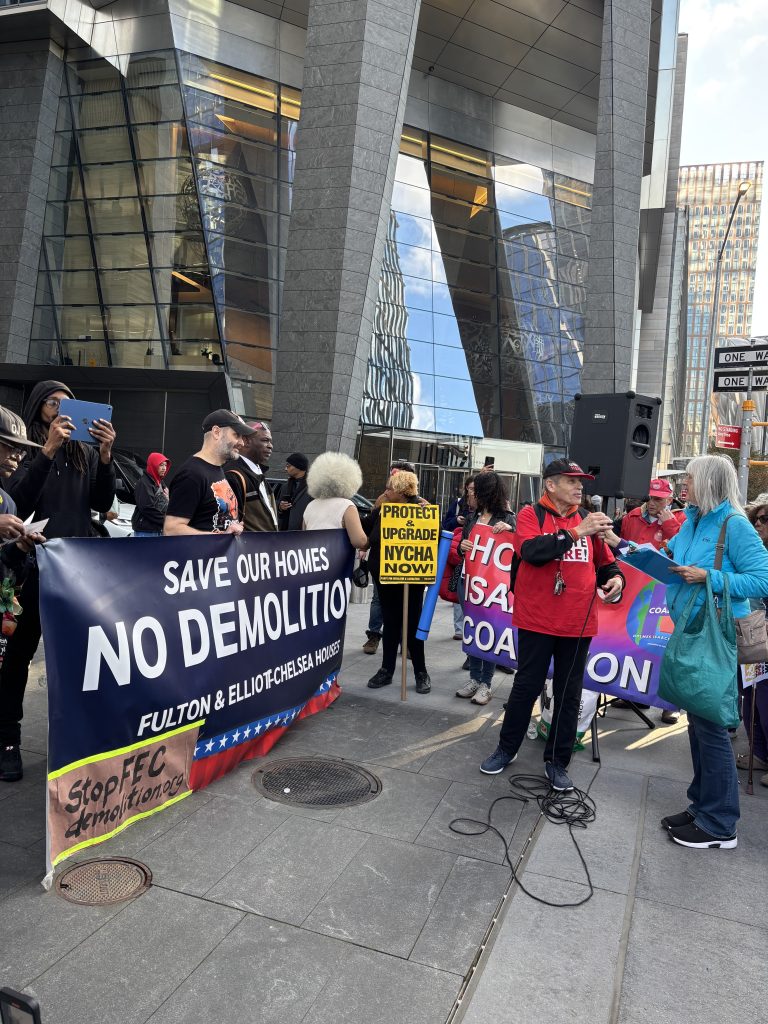
Public housing residents and advocates rallied on November 8 against the New York City Housing Authority’s plan to have a private developer demolish and rebuild the Fulton and Elliott-Chelsea Houses, constructing new market-rate apartments on NYCHA-owned land. The Fulton and Elliott-Chelsea (FEC) Tenants Against Demolition filed a lawsuit to stop the plan in late October.
NYCHA announced in June 2023 that it planned to lease the land under the two developments—on two separate sites between West 16th Street and West 27th Drive, between Ninth and Tenth avenues—to The Related Companies and Essence Realty. Over the next 15 years, the developers would gradually tear down the public-housing buildings, which are home to 2,056 apartments, and move the residents to new buildings in the federal Section 8 program as they are completed. It would also construct about 2,500 luxury and about 1,000 so-called “affordable” apartments on the same land.
Public-housing developments have been torn down in many U.S. cities, such as St. Louis and New Orleans, over the past 40 years. New York City’s public-housing system, home to an estimated 500,000 people, has been the exception. Critics of the Fulton and Elliott-Chelsea demolition worry that it could set a precedent for further elimination of NYCHA units, which are by far the largest source of apartments under $1,000 a month in the city.
NYCHA in 2019 sought proposals to rehabilitate the two developments, but then claimed that its original estimate of the cost had been far too low. The authority now appears to believe that the only way to pay for its backlog of repairs, estimated at $78 billion, is by privatization partnerships that let developers build market-rate housing on its land and give it access to Section 8 funding.Fulton and Elliott-Chelsea residents have been resisting this plan, fearing displacement. NYCHA and the developers say that in their new units, residents would continue to pay at most 30% of their income toward their rent, and that only 6% of the residents, the 111 households in the Chelsea Addition and Fulton 11 buildings, will be required to move to temporary apartments during the demolition and reconstruction process. Chelsea Addition houses only elderly people.
Fulton and Chelsea-Elliot Houses residents have been resisting this plan for years, living in fear of displacement and paying higher rents.
But the plan involves ending the residents’ traditional public housing Section 9 tenancies and replacing them with Section 8 leases, in which the federal government pays the difference between 30% of the tenant’s income and an amount slightly below the median market rent in the area—well over $3,000 a month in Chelsea.
Many residents are wary of the developers’ promises. “I’ve heard the developers speak a lot, and it feels like day-to-day what the developers are promising changes a lot. I’m just at the point where I don’t trust what the developers say,” Simon Z., 56, a Fulton Houses resident, told the Indypendent at the Nov. 8 rally, speaking in Chinese through a translator. “I feel like if there are any issues with the project or the building in the future, it’s going to be the tenants who have to bear the consequences, it’s not going to be the developers.”
“These are elderly tenants, low-income, disabled, very vulnerable people,” neighborhood housing advocate Marni Halasa said.
Displacement Begins
The displacement process began in late July, when tenants in Fulton 11—two conjoined buildings on West 19th Street—and Chelsea Addition received notices from NYCHA telling them they had to vacate their homes.
The notices stated that residents needed to leave by October 26, in 90 days, otherwise “legal action will be commenced against you, including proceedings seeking to evict you and terminate your tenancy.” On October 27, NYCHA issued “termination of tenancy” notices to the Chelsea Addition residents who had not yet left.
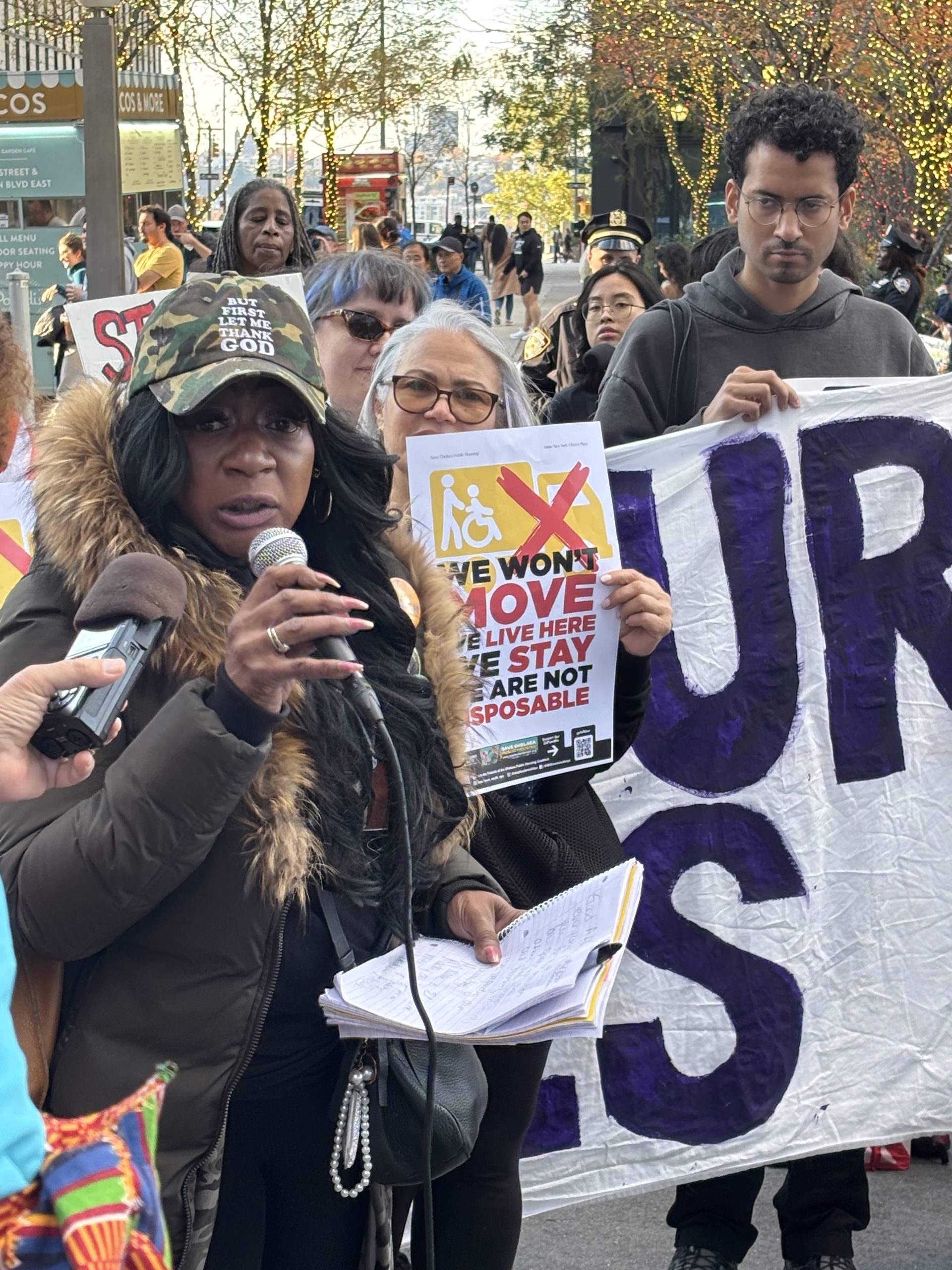
“I am here because I am fighting for my sanctuary. My home is more than just my home. My home is where I feel safe,” Chelsea Addition resident Maria Santos, 76, said during the Nov. 8 rally.
According to a spokesperson for Essence, 92 out of the 111 households in the Chelsea Addition and Fulton 11 buildings have signed new leases, and have either moved or are in the process of moving.
The day after the termination of tenancy notices were issued, FEC Tenants Against Demolition, represented by TakeRoot Justice, filed a lawsuit against NYCHA, seeking a court order to halt the eviction and demolition process.
The suit argues that NYCHA is exceeding its authority, defined in the state Public Housing Law as to provide low-income housing, since the law does not detail an exception for NYCHA “to build market-rate housing on public housing land.” It also says that NYCHA is skirting the city’s Uniform Land Use Review Process (ULURP), the public review required by the city charter for “[h]ousing and urban renewal plans and projects pursuant to city, state, and federal housing laws.” That review process can take at least seven months to obtain an approval.
Advocates and residents argue that, through the vendor Housing Opportunities Unlimited (HOU), residents are being coerced into vacating their homes.
In one instance, Halasa said, HOU packed a resident’s belongings even though she had not agreed to vacate. (After a court hearing on the lawsuit Nov. 5, the tenants’ attorney said that a family member had signed the agreement for her.) Halasa also noted that police came and told tenants that they needed to move because the building had been sold, which is not yet true.
“They don’t respect anybody. They just do what they want to do,” Santos said. “They’ve taken the directory off the building, which can cause other people to believe that no one’s in the building, and puts the residents that are there in danger.”
The next hearing on the lawsuit is scheduled for Dec. 4.
“The next step forward for me is to stay there all the way to the end,” Santos said. “I am not moving. I am not listening to them, and if they want to move me out of there they have to take me to court.”
The Indypendent is reader-funded. We publish a free monthly newspaper, a website, a weekly radio show on WBAI-99.5 FM and more. To make a one-time or recurring monthly donation, click here.
Related Coverage
-

Young and Old March Together Against the Gov. Hochul and the Williams-NESE Pipeline
The governor’s reversal of her previous opposition to the pipeline has outraged environmentalists.
-

The Latest Developer Scam: City Charter Revisions That Claim to “Fast-Track Affordable Housing”
Three of the six ballot questions (numbers 2-4) that New York City voters are facing are falsely advertised as… -

Journal Square Mega-Development Plagued by Worker Safety Violations, Union Says
The real estate developer and the general contractor are using non-union immigrant workers that are easier to exploit.